


Are Memory Foam Beds Good for Old Dogs? 2026 Review
Table of Contents
- Quick Comparison: Best Memory Foam Beds for Old Dogs
- Are Memory Foam Beds Good for Old Dogs? The Honest Answer
- Signs of Arthritis in Senior Dogs (and When to Switch Beds)
- Memory Foam vs Egg Crate Dog Beds: Which Helps Senior Joints More?
-
5 Memory Foam Beds and Joint-Friendly Options Reviewed
- Dog Stairs Ramp for Bed: Best for High Beds and Mobility Issues
- Foldable 2-In-1 Dog Stairs: Best for Small Apartments
- Elevated Dog Cooling Bed: Best for Heat Retention Concerns
- Large Outdoor Indoor Dog House: Best for Big Breeds Year-Round
- Small Quiettime Deluxe Coco Chic Pet Bed: Best Budget Crate Option
- How to Help an Old Dog Sleep Better: Setup Tips That Work
- Toxicity, CertiPUR-US, and Off-Gassing: What to Check Before You Buy
- Conclusion: Which Bed Fits Your Senior Dog Best?
- Frequently Asked Questions
Last Updated: September 16, 2026
Quick Comparison: Best Memory Foam Beds for Old Dogs
Are memory foam beds good for old dogs? For most senior dogs with joint pain, yes. The right memory foam bed distributes weight away from pressure points, cushions arthritic joints, and helps an aging dog stay asleep. The catch: not every "memory foam" bed is built the same, and the wrong one can trap heat or collapse under a larger dog.
| Option | Price | Best For | Key Feature |
|---|---|---|---|
| Dog Stairs Ramp for Bed | $377.99 | High beds, mobility issues | High-density foam, 50 lb capacity |
| Foldable 2-In-1 Dog Stairs | $99.13 | Small apartments | Folds into a footstool |
| Elevated Dog Cooling Bed | $171.95 | Heat retention concerns | Raised airflow design |
| Large Outdoor Indoor Dog House | $738.13 | Big breeds, year-round | Indoor/outdoor durability |
| Small Quiettime Deluxe Pet Bed | $23.80 | Budget crate option | Machine washable, fits 24-inch crate |
Are Memory Foam Beds Good for Old Dogs? The Honest Answer
Memory foam beds are good for old dogs because they reduce pressure on joints, hips, and elbows while supporting skeletal alignment during rest. The foam conforms to your dog's body, spreading weight evenly instead of concentrating it at the heaviest contact points.

Signs of Arthritis in Senior Dogs (and When to Switch Beds)
Canine osteoarthritis is a progressive, irreversible breakdown of the cartilage that cushions a joint. As cartilage thins, bone rubs on bone and surrounding muscles weaken from disuse. That's why the surface your dog rests on for 12 to 14 hours a day matters: a bed that concentrates pressure on a damaged joint keeps the inflammation cycle running overnight.
Early Warning Signs Most Owners Miss
- Slowing down on stairs or refusing them entirely
- Hesitating before jumping onto the couch or bed
- Shifting position frequently at night instead of sleeping through
- Licking or chewing at a specific joint
- Reluctance to go on walks your dog used to love
- Lagging behind on walks, or a shortened stride in the rear legs
- Audible clicking or popping from a hip or knee
- Muscle wasting along the spine or hindquarters
- Irritability when touched near the hips, elbows, or lower back
If you notice two or more of these, the bed is the cheapest thing to change first. A common mistake is buying pain supplements before fixing the surface the dog spends half its life on.
How Veterinarians Actually Assess Arthritis
A vet typically grades lameness on a 0-to-4 scale, palpates each joint for swelling and crepitus (the grinding sensation of bone on bone), and measures range of motion. Many also use a body condition score, because extra weight multiplies the load on arthritic joints. Radiographs confirm the diagnosis.
Pressure Point Relief and Weight Distribution Explained
Pressure point relief is the reduction of concentrated force on bony areas like hips, elbows, and shoulders when a dog lies down. Memory foam achieves this by conforming to the body's shape, increasing the surface area that carries the dog's weight.
When to Switch Beds: A Simple Decision Rule
Switch beds when any of these is true:
- Your dog takes more than a minute to rise after a nap
- You can feel the floor through the bed when you press it with your palm
- The foam stays compressed after your dog stands up
- Your dog circles repeatedly before lying down, or refuses the bed entirely
- The cover has been washed so often it no longer stays on
A supportive bed is not a cure for arthritis. It's the cheapest, lowest-risk intervention you can make, and it stacks with weight management, joint supplements, and veterinary care.
Memory Foam vs Egg Crate Dog Beds: Which Helps Senior Joints More?
Memory foam beds outperform egg crate beds for senior joints in almost every case. Egg crate foam is cheap and offers mild cushioning, but it compresses permanently under a dog's body weight within weeks.
High-Density Foam vs Soft Conforming Foam
High-density foam resists compression and provides a firm, supportive base. Soft conforming foam feels plusher but bottoms out faster under heavy dogs.
5 Memory Foam Beds and Joint-Friendly Options Reviewed
Every pick below comes from the FurEver Finds catalog and is chosen for a specific senior-dog problem.
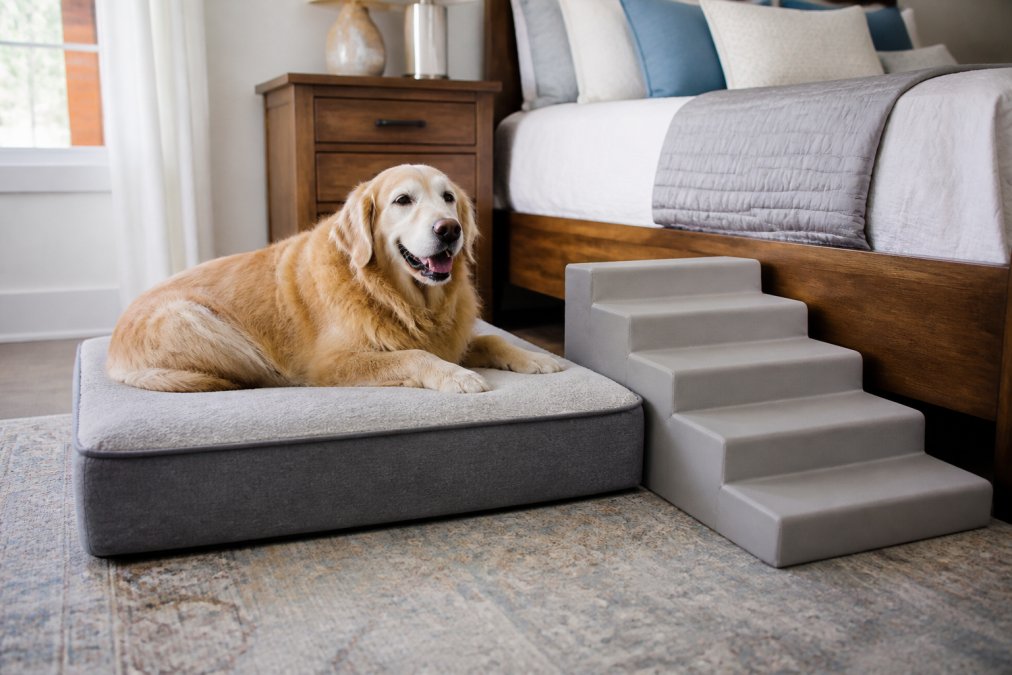
Dog Stairs Ramp for Bed: Best for High Beds and Mobility Issues
If your dog can no longer jump onto the bed, the problem isn't the mattress, it's the climb. This ramp solves that with high-density foam steps that reduce joint and bone stress. It supports pets up to 50 pounds and has a textured non-slip surface with an anti-slip base.
- Pros: Reduces jumping impact, washable cover, stable on hard floors
- Cons: Needs a full day to expand after unboxing
Foldable 2-In-1 Dog Stairs: Best for Small Apartments
Space is the real constraint for many senior dog owners. This unit folds into a compact footstool in seconds, so it disappears when your dog isn't using it. The 17.13-inch height matches most sofas and beds, and the gradual incline suits arthritic and aging dogs.
- Pros: Folds flat, gentle incline, doubles as furniture
- Cons: Best suited to small and medium dogs
Elevated Dog Cooling Bed: Best for Heat Retention Concerns
Memory foam traps body heat, a genuine problem for senior dogs who run warm or live in humid climates. This elevated bed lifts your dog off the ground so air circulates underneath, and keeps your pet off hot, damp, or dusty surfaces.
- Pros: Promotes airflow, easy-clean surface, indoor/outdoor
- Cons: Not a pressure-relief foam bed, so pair it with a foam pad for arthritic dogs
Large Outdoor Indoor Dog House: Best for Big Breeds Year-Round
Large senior dogs need room to stretch out without their joints locking up. This house offers a spacious interior for medium to large breeds, with durable construction and airflow for indoor or outdoor settings.
- Pros: Roomy for big dogs, year-round use, easy to maintain
- Cons: A shelter, not a foam bed, so add cushioning inside
Small Quiettime Deluxe Coco Chic Pet Bed: Best Budget Crate Option
Not every senior dog needs a $300 bed. This overstuffed, plush bed fits a standard 24-inch crate and measures 22 x 17 inches, sized for small breeds between 12 and 20 pounds. It's machine washable, dryer safe, and has a no-slip bottom.
- Pros: Affordable, washable, fits standard crates
- Cons: Not for excessive chewers
How to Help an Old Dog Sleep Better: Setup Tips That Work
Helping an old dog sleep better comes down to four things: the right surface, easy access, temperature control, and accident management. Get those right and most senior dogs settle faster and wake less often.
Temperature Regulation: The Memory Foam Problem Nobody Warns You About
Memory foam is dense, and dense foam traps body heat. For a senior dog already running warm, or one in a humid climate, a solid slab of memory foam can turn a supportive bed into a sauna by 2 a.m. That's why so many older dogs start the night on the bed and end it on the tile floor.
- A gel-infused foam layer. Cooling gel beads or a graphite-infused top layer pull heat away from the contact surface.
- An open-cell or ventilated foam core. Open-cell foam moves air through the bed instead of insulating it.
- A breathable, moisture-wicking cover. Look for covers described as breathable or mesh-paneled rather than waterproof-only.
- An elevated cot as a summer swap. A raised cot with a breathable fabric lets air circulate underneath. Pair it with a thin memory foam pad for joint support without the heat trap.
Incontinence-Friendly Features: What to Look For
Senior dogs develop incontinence gradually. By the time it starts, you want a bed you can strip and wash the same day, not one you have to throw away.
The features that matter:
- A waterproof liner between the foam and the cover. This is the single most important spec. Without it, urine soaks into the foam core and the bed is done.
- A removable, zippered cover. Velcro and elastic corners fail after a few washes. Zippers hold.
- Machine washable and dryer safe. If the cover needs to air-dry for two days, you will not keep up.
- A spare cover. Two covers means one is always clean.
Mobility and Entry Height: The Accessibility Factor Most Reviews Skip
A bed your dog cannot climb into is useless, no matter how good the foam is. Senior dogs with hip dysplasia, rear-leg weakness, or post-surgical restrictions struggle with high-bolster beds and thick mattresses.
What to look for:
- Low-profile or step-in designs. A bed with a low front edge and a slightly raised back gives your dog a clear entry point without a wall to climb over.
- A firm, non-collapsing edge. A soft bolster that squashes under a paw gives no purchase. The entry edge should be firm enough to bear weight.
- A non-slip base. Hardwood and tile are the enemy of a dog with weak rear legs. Look for a rubberized or textured bottom.
- Ramps and stairs for human beds and couches. If your dog still sleeps on your bed, a foam ramp or a set of pet stairs removes the jump entirely. Match the height of the stairs to the height of your bed, and check the weight capacity against your dog's current weight, not its puppy weight.
Routine, Drafts, and the Rest of the Setup
- Keep the bed in a draft-free spot. Cold air stiffens arthritic joints overnight. Move the bed away from doors, vents, and windows.
- Layer for warmth and cooling. A washable cover plus a breathable base lets you adjust seasonally without buying a second bed.
- Stick to a routine. Senior dogs sleep better when bedtime is predictable.
- Add a night light. Older dogs with cloudy eyes or early vision loss navigate better with a low light near the bed and the path to the door.
Toxicity, CertiPUR-US, and Off-Gassing: What to Check Before You Buy
CertiPUR-US is a certification program that tests foam for certain heavy metals, phthalates, and ozone depleters, and limits volatile organic compound emissions (About Certified Foam). Foam that carries it has been screened for the substances most likely to affect a dog that sleeps on the bed for years.
Conclusion: Which Bed Fits Your Senior Dog Best?
The hard part isn't deciding whether memory foam helps. It's matching the right setup to a dog that can no longer jump, may run warm, and might have accidents. Get that wrong and you've spent money on a bed your dog avoids.
Frequently Asked Questions
What type of bed is best for a senior dog with arthritis?
A high-density memory foam bed with a supportive base and a low entry height works best for arthritic dogs. The foam conforms to the body and spreads weight across pressure points, which reduces strain on hips and elbows. Look for a bed thick enough to cushion without sinking, a waterproof liner if accidents happen, and a machine-washable cover. Pairing the bed with foam pet stairs helps your dog get on and off furniture without jumping, which protects sore joints during flare-ups.
Do memory foam beds help with joint pain in old dogs?
Memory foam beds can ease joint pain by distributing weight evenly and reducing pressure on bony areas like hips, elbows, and shoulders. The conforming surface supports skeletal alignment and can help dogs with arthritis, hip dysplasia, or post-surgical recovery rest more comfortably. Foam quality matters: high-density foam holds its shape longer and offers firmer orthopedic support, while cheap low-density foam flattens within months. A memory foam bed is not a treatment for joint pain, but it can make rest easier for a senior canine.
How do I choose the right thickness and firmness for my old dog's bed?
Match thickness to your dog's weight and sleep style. Small dogs under 25 lbs do well with 3 to 4 inches of high-density foam. Larger breeds and dogs with chronic pain need 4 to 6 inches so hips do not bottom out. Firmness should support without being rock hard: a bed that conforms slightly but springs back holds skeletal alignment better than one that sinks. If your dog struggles to step up, a lower profile bed or foam stairs reduces the jump height.
What are the signs my dog needs an orthopedic bed?
Watch for stiffness when rising, reluctance to jump on the couch, pacing at night, shifting positions frequently, or whining when lying down. Visible signs of arthritis in senior dogs include limping after rest, slowed walks, and avoiding stairs. If your dog avoids a favorite sleeping spot or wakes up stiff, the current bed may not be providing enough pressure point relief. A switch to a supportive memory foam bed and a set of pet stairs often makes a noticeable difference within the first week.
Are memory foam beds safe, and what does CertiPUR-US mean?
CertiPUR-US is a voluntary certification for foam used in pet and human bedding. It confirms the foam is made without ozone depleters, heavy metals like mercury and lead, and certain flame retardants, and that it meets limits for VOC emissions. New foam may have a faint smell from off-gassing, which usually fades within a few days in a ventilated room. If you want proof of material safety, ask the seller for the certification before buying, especially for dogs with allergies or respiratory issues.