


Cat Anxiety vs Boredom Symptoms: A 2026 Comparison
Table of Contents
- Cat Anxiety vs Boredom Symptoms: How They Overlap
- Why the Two Get Confused
- Comparison Table: Anxiety vs Boredom Symptoms at a Glance
- Signs of an Anxious Cat
- Signs of a Bored Cat and Destructive Behavior
- Cat Enrichment Ideas That Target Both Problems
- How to Calm an Anxious Cat: A Step-by-Step Approach
- Breed-Specific Predispositions and When to See a Vet
- Frequently Asked Questions
Last Updated: September 19, 2026
Cat Anxiety vs Boredom Symptoms: How They Overlap
A cat that shreds curtains, yowls at 3 a.m., or hides under the bed is trying to tell you something. The challenge is that cat anxiety vs boredom symptoms look almost identical, and treating the wrong one wastes time and money.
Why the Two Get Confused
Most owners misread the signals because the visible behavior is the same: both cats scratch furniture, vocalize, and sleep at odd hours. The difference lives in the trigger, not the symptom.
Comparison Table: Anxiety vs Boredom Symptoms at a Glance
A symptom list only tells you what you're seeing; a diagnostic framework tells you what to do about it. Read the table below as a decision tool: each row pairs a symptom with the question that separates anxiety from boredom, plus the first move to make.
| Symptom | Anxious Cat | Bored Cat | The separating question | First move |
|---|---|---|---|---|
| Timing | Clusters around a stress trigger (new person, move, schedule change) | Random, often late evening or pre-dawn | Did the behavior start within days of a specific change? | If yes → anxiety track. If no → boredom track. |
| Body language | Crouched, tail tucked, ears flattened, pupils dilated in normal light | Relaxed or alert body, tail up, ears forward | Does the cat look braced or ready to play? | Braced → reduce stimulation. Ready → add stimulation. |
| Vocalization | Low growls, distress meows, chirps at nothing | Loud, demanding yowls directed at you | Is the sound aimed at you or at the room? | Aimed at you → boredom. Aimed at nothing → anxiety. |
| Appetite | Drops, grazes, or stops eating | Normal or increased, may beg more | Is food being refused or demanded? | Refused → vet visit. Demanded → enrichment gap. |
| Grooming | Compulsive overgrooming, bald patches on belly or inner legs | Normal coat, maybe more shedding from activity | Are there bare spots or skin irritation? | Bare spots → vet + anxiety plan. |
| Hiding | Hides from people, noise, and normal household activity | Hides only to ambush toys or pounce on passing feet | Is the cat hiding from the world or hunting it? | From the world → anxiety. Hunting → boredom. |
| Response to play | Refuses, freezes, or walks away mid-session | Engages eagerly, escalates, never seems satisfied | Does play calm the cat or wind it up further? | Calms → boredom. Winds up or avoids → anxiety. |
| Sleep | Fragmented, hypervigilant, wakes at small sounds | Normal sleep, but intense active periods when awake | Is the cat resting or on guard? | On guard → anxiety. Resting but destructive → boredom. |
| Litter box | Avoidance, or use only when no one is nearby | Normal use | Any change in litter box habits? | Yes → rule out medical first. |
How to Read This Table
Don't score the whole table. Find the two or three rows that match your cat most strongly, then check whether they point the same direction. A cat that hides from noise, refuses food, and freezes during play shows a consistent anxiety pattern; a cat that yowls at you, knocks things off shelves, and escalates during wand play shows a consistent boredom pattern.
The One Pattern That Matters Most
One contrast drives most diagnoses: anxiety shuts a cat down, while boredom fires it up. An anxious cat withdraws from the environment; a bored cat attacks it. When you can't tell which you're seeing, ask whether your cat is trying to escape the room or rearrange it.
Signs of an Anxious Cat
An anxious cat shows a cluster of physical and behavioral clues pointing to chronic stress rather than restlessness. Body language is the giveaway: a stressed cat holds its tail low or tucked, flattens its ears, and often has dilated pupils even in bright light.
Watch for these signs:
- Hiding behavior that lasts hours, not minutes
- Pacing or restlessness that never settles into play
- Compulsive grooming, especially on the belly or inner legs
- Appetite fluctuations, from grazing to full refusal
- Litter box avoidance
- Startling at normal household sounds
Physical and Behavioral Clues
Physical signs often show up before behavioral ones: a cat under chronic stress may shed more, develop skin irritation from overgrooming, or lose weight. Separation anxiety commonly shows as destruction near doors or windows when you leave. A cat that suddenly starts hiding after years of social behavior is telling you something changed.
Signs of a Bored Cat and Destructive Behavior
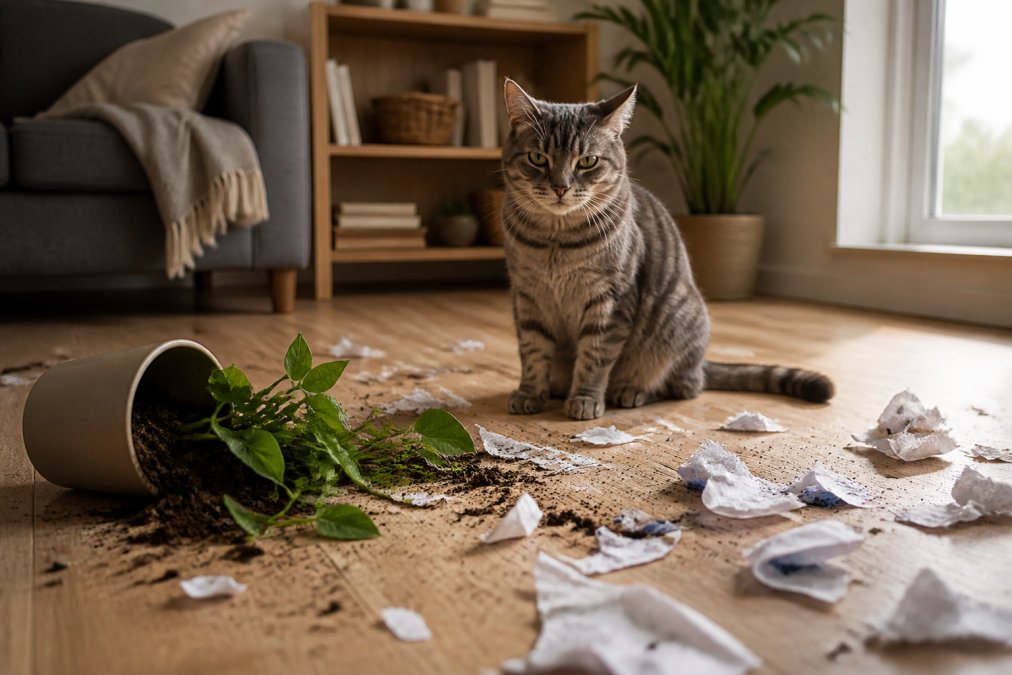
A bored cat is not a relaxed cat. It is under-stimulated with energy to burn, and that energy has to go somewhere, usually furniture, curtains, and houseplants.
Look for:
- Scratching furniture instead of the post
- Knocking objects off shelves for attention
- Nighttime vocalization and zoomies
- Chewing cords or plants
- Following you room to room, demanding engagement
When Boredom Turns Destructive
Destruction is the most expensive symptom of boredom, and it is preventable. A sedentary indoor lifestyle with no vertical space, no foraging, and no hunting outlet creates a cat that entertains itself. The fix is not punishment, which both anxious and bored cats handle poorly, but a richer indoor environment.
Cat Enrichment Ideas That Target Both Problems
Enrichment works on both conditions because it addresses the same need: a cat with something to do has less reason to act out. The difference is the intensity and structure you apply.
Start with these cat enrichment ideas:
Catnip Interactive Scratcher Toy →
- Add vertical space with cat trees and wall shelves
- Rotate toys weekly so novelty stays high
- Use foraging toys that release kibble as your cat plays
- Schedule two dedicated play sessions daily
- Set up a window perch with a bird feeder view
Interactive vs. Passive Enrichment
Interactive enrichment requires you or a toy to respond in real time: wand play, fetch, or a rolling ball your cat chases. Passive enrichment is static: a scratching post, a window perch, or a puzzle feeder.
A few FurEver Finds picks that cover both categories:
- Catnip Interactive Scratcher Toy ($32.99): satisfies scratching instincts and adds catnip-driven play
- Interactive Cat Rolling Ball Toy ($34.99): sparks chasing and pouncing for independent play
- Interactive Electronic Cat Toy ($165.01): automatic movement for cats home alone
- Interactive Puzzle Ball ($26.99): turns mealtime into mental stimulation
- Cat Scratching Post Sisal ($79.15): a durable outlet that protects your furniture
How to Calm an Anxious Cat: A Step-by-Step Approach
Knowing how to calm an anxious cat starts with removing or managing the stressor, not adding stimulation. A practical sequence:

- Identify the trigger. Use your behavior log to find what changed.
- Create a safe zone. A quiet room with food, water, and a litter box gives your cat a retreat.
- Keep routines fixed. Feed and play at the same times daily.
- Introduce slow, predictable contact. Let your cat approach you.
- Add calming enrichment. Puzzle feeders and scratching posts redirect nervous energy.
- Talk to your vet. Persistent anxiety may need a medical or behavioral plan.
Breed-Specific Predispositions and When to See a Vet
Breed is a starting hypothesis, not a diagnosis. But it changes how fast a cat deteriorates and which symptom shows up first, so it's worth knowing before you build a plan.
How Boredom Becomes Anxiety
Most articles treat boredom and anxiety as separate problems. In practice, they sit on a continuum, and chronic boredom is one of the most common on-ramps to clinical anxiety. A cat is a hunter with a daily cycle of stalk, chase, catch, and eat. When that cycle never completes, no hunting outlet, no foraging, no unpredictable movement to track, the arousal system stays switched on with nowhere to discharge.
Breed Patterns Worth Knowing
- Bengals and Savannahs. High-drive, high-energy breeds that need intense physical and mental stimulation daily. Under-stimulated, they don't shut down, they invent games, often at the expense of your shelves, cords, and houseplants. Their boredom symptoms escalate faster than almost any other breed.
- Siamese and other Oriental breeds. Famously vocal and socially dependent. They deteriorate quickly in a quiet, under-stimulated home, and their boredom often presents as loud, persistent meowing directed at the owner rather than destruction.
- Abyssinians and other active shorthairs. Athletic and curious. Boredom shows up as climbing, counter-surfing, and knocking objects off surfaces to watch them fall.
- Persians, Exotic Shorthairs, and other flat-faced breeds. More sedentary by nature and often more prone to stress-related withdrawal. Their anxiety symptoms tend to look like hiding and appetite changes rather than destruction.
- Ragdolls and British Shorthairs. Generally calm and tolerant, which means their boredom is easy to miss until it tips into overgrooming or litter box avoidance.
A sedentary breed in an enriched home can still develop anxiety from a specific trigger. A high-drive breed in a quiet home can develop anxiety from the boredom. Breed tells you which direction to look first, not what you'll find.
When to See a Vet
A veterinary visit is not a last resort, it's the step that keeps you from spending money on the wrong fix. Many medical conditions mimic behavioral problems, and some are serious enough that waiting costs you time you don't get back.
Call your vet if you see:
- Sudden appetite loss lasting more than 24 hours
- Bald patches, skin irritation, or sores from compulsive grooming
- Weight loss or weight gain without a diet change
- Lethargy or hyperactivity that is new
- Any behavior change that appears overnight
- Litter box avoidance, especially in a cat with a previously clean record
- Increased thirst or urination alongside behavior changes
Frequently Asked Questions
What helps anxiety in cats naturally?
Start with predictable routines, a quiet hiding spot, and interactive play sessions that let your cat act on hunting instincts. Puzzle feeders and rolling ball toys give nervous cats a sense of control because they decide when to engage. Pheromone diffusers can take the edge off mild stress. If your cat hides for days, stops eating, or grooms bald patches, that goes beyond natural remedies and needs a veterinary consultation.
Can boredom in cats lead to destructive behavior?
Yes. A bored cat with no outlet for scratching, chasing, or climbing often redirects that energy into furniture, curtains, and cords. The fix is environmental enrichment: a sisal scratching post, a puzzle feeder that releases kibble as your cat plays, and short daily play sessions. Destructive tendencies usually drop once the cat has a legitimate target for its energy and something to think about during the day.
How can I tell if my cat is unhappy or just under-stimulated?
Look at the pattern. A bored cat is restless and seeks attention, knocking things over or meowing at you in the evening. An anxious cat withdraws, hides, overgrooms, and reacts to changes like a new person or a moved litter box. Boredom eases quickly when you add play and enrichment. Anxiety persists even after enrichment and often gets worse with routine changes.
How long does it take for a cat to destress?
Mild stress from a routine change often settles in a few days to two weeks once the environment feels predictable again. Chronic stress tied to a household disruption can take a month or longer. Keep meals, play, and quiet time on a fixed schedule, and give your cat vertical space to retreat to. If symptoms last past a month or your cat stops eating, schedule a veterinary consultation.
What are the physical signs of stress in a cat?
Watch the body language: flattened ears, a tucked tail, dilated pupils, tense posture, and a low crouch. Stress can also show up as excessive vocalization, pacing, hiding behavior, appetite fluctuations, and compulsive grooming that leaves thin patches. Some cats get lethargic while others turn hyperactive. Any sudden shift in sleeping patterns or appetite warrants a vet check before you assume it is behavioral.