


Eco-Friendly Cat Litter vs Clay: Which Is Better?
Table of Contents
- Eco-Friendly Cat Litter vs Traditional Clay: The Core Differences
- What Traditional Clay Litter Actually Is
- What Makes Cat Litter Eco-Friendly
- Environmental Impact: Strip Mining, Landfill Waste, and Carbon Footprint
- Health and Safety: Silica Dust, Respiratory Irritation, and Cat Health
- How to Transition Your Cat to New Litter Without Rejection
- Best Natural Cat Litter for Odor Control: What Actually Works
- Cost-Per-Use, Tracking, and Mess: The Practical Trade-Offs
- Frequently Asked Questions
Last Updated: September 10, 2026
Eco-Friendly Cat Litter vs Traditional Clay: The Core Differences
Choosing between eco-friendly cat litter and traditional clay comes down to one trade-off: environmental and health costs versus convenience. Eco-friendly cat litter is made from renewable, biodegradable materials such as pine, paper, wheat, corn, or tofu, rather than strip-mined clay.
Traditional clay dominates because it clumps fast and masks odor with minimal effort. Eco-friendly options demand more attention to scooping and transition, but avoid the mining damage and dust that come with clay.
What Traditional Clay Litter Actually Is
Traditional clay litter is made from sodium bentonite, a mineral harvested through strip mining, which removes topsoil and vegetation across large surface areas to reach shallow clay deposits (usgs.gov).
Its main selling point is clumping ability: sodium bentonite swells and binds on contact with moisture, trapping urine in firm, easy-to-remove clumps. That explains why clay still holds the largest share of the litter market.
The catch is what happens after the box. Spent clay litter is not biodegradable, so it sits in landfill indefinitely, staying roughly as it was, just heavier.
What Makes Cat Litter Eco-Friendly
Cat litter earns the eco-friendly label when its raw materials are renewable, its production avoids strip mining, and the used product breaks down rather than persisting in a landfill. Common bases include pine pellets, recycled paper, wheat, corn, and tofu.
Biodegradability is the defining trait. Natural fibers decompose over time, and many formulas are marketed as compostable, though you should check local rules before composting used litter.
Sustainable sourcing matters too. Pine and paper come from managed forests and recycled streams, keeping the carbon footprint lower than mining and processing clay. For cat owners weighing environmental impact against daily performance, this is where eco-friendly litter wins outright.
Environmental Impact: Strip Mining, Landfill Waste, and Carbon Footprint
The environmental gap between the two categories is real: clay starts with strip mining and ends as permanent landfill waste, while eco-friendly litter starts with renewable resources and breaks down after use. But the difference is more nuanced than "natural good, clay bad," and the stages of a product's life matter more than the label.
Stage 1: Raw Material Extraction
Sodium bentonite is surface-mined in large open pits where topsoil and overburden are stripped away to reach shallow deposits (usgs.gov). Reclamation is required, but reclaimed land rarely returns to its original ecological function within a human timeframe, and the extraction footprint per pound is high because raw clay is heavy.
Plant-based litters draw from very different supply chains:
- Pine: A byproduct of lumber milling, so the material is already harvested for another purpose. Sourcing from managed forests matters more than the species itself.
- Recycled paper: Diverts post-consumer waste from landfills and requires no new fiber harvest.
- Wheat and corn: Often agricultural byproducts (middlings, cobs, or stalks) that would otherwise be burned or tilled back in.
- Tofu: Made from soybean pulp, a byproduct of soy milk and tofu production.
That byproduct status is the biggest reason plant-based litters carry a lower extraction-stage burden: no new land is cleared for the litter.
Stage 2: Processing and Manufacturing
Clay processing is energy-intensive: mining, hauling, drying, and sometimes coating with additives or fragrance. Because clay is dense, every ton moved costs fuel. Plant fibers need less drying and processing, though pelletized pine and extruded tofu require some heat and pressure.
A full lifecycle assessment (LCA) would help here, but consumer-facing comparisons of clay versus plant-based litter are still uncommon, so treat any single-number carbon claim with caution. The direction is well established: mining and processing favor plant-based materials, and disposal favors them even more.
Stage 3: Transport
Weight is the overlooked variable: clay is heavy, so shipping it burns more fuel per bag than pine, paper, or corn. To reduce transport impact, buy a plant-based litter produced or sourced near your region.
Stage 4: Use Phase
During use, the two categories are closer than people assume. Both require scooping, both generate some dust, and both consume water and energy if you wash the box. The main difference is dust volume: clay generates more airborne particulate during pouring and scooping, while most plant-based litters generate less.
Stage 5: Disposal
This is where the categories diverge most sharply.
- Clay: Sodium bentonite does not biodegrade, so spent clay sits in landfill essentially unchanged and cannot be composted.
- Pine and paper: Break down over months to a few years in a landfill, and can be composted in many home systems if managed correctly.
- Wheat, corn, and tofu: Biodegrade readily, but composting used cat litter carries a risk: cat feces can contain Toxoplasma gondii, and most municipal compost programs prohibit pet waste for that reason.
"Compostable" on a bag does not mean your city will accept it in the green bin. Many municipal programs exclude pet waste, and home compost piles that include cat litter should not be used on food crops. Check your local solid waste authority's rules first.
The Bottom Line on Environmental Impact
Across the full lifecycle, plant-based litters win on extraction, transport, and disposal, and are at least comparable during use. The size of the win depends on where the material comes from, how far it travels, and how your community handles waste: a locally sourced, byproduct-based litter composted at home has the smallest footprint, while clay hauled across the country and landfilled has the largest. Knowing which stage drives the difference is more useful than any single eco-label.
Health and Safety: Silica Dust, Respiratory Irritation, and Cat Health
Clay litter's biggest hidden cost is dust. Scooping and pouring kick up fine particles, and crystalline silica dust is a known respiratory irritant for cats and people (osha.gov). For households with asthma, allergies, or a cat that spends a lot of time in the box, that dust is worth taking seriously.
Eco-friendly litters are typically marketed as dust-free or low-dust, though pine and paper still produce some fines. The bigger win is what they leave out: no silica dust, and fewer added fragrances and synthetic deodorizers that bother sensitive cats.
Feline health matters here too: a litter that irritates paws or airways can trigger avoidance and accidents outside the box, and non-toxic, low-dust formulas reduce that risk, especially for kittens and senior cats.
How to Transition Your Cat to New Litter Without Rejection
Transition your cat gradually over one to two weeks by mixing a small amount of new litter into the old, then increasing the ratio every few days. A sudden swap is the most common reason owners give up on eco-friendly litter.
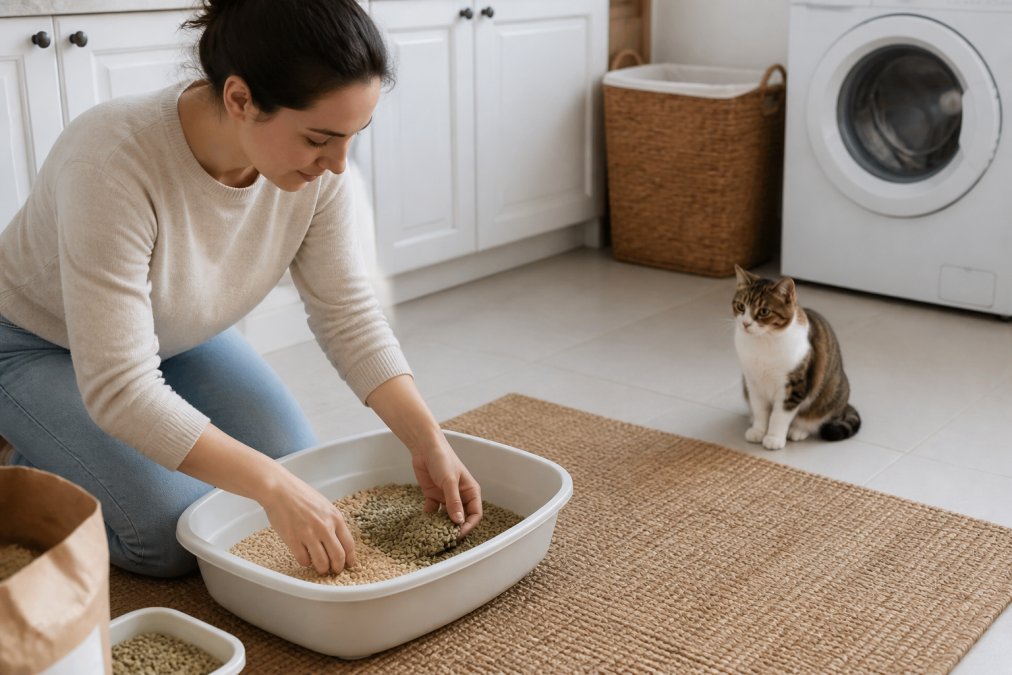
Here's a transition schedule that works for most cats:
| Phase | Old Litter | New Litter | Duration |
|---|---|---|---|
| Week 1 | 75% | 25% | 3-4 days |
| Week 2 | 50% | 50% | 3-4 days |
| Week 3 | 25% | 75% | 3-4 days |
| Week 4 | 0% | 100% | Ongoing |
Keep the box in the same spot, scoop daily, and add a second box during the switch if you have room. If your cat protests, slow down. A common mistake is doing the whole swap in one day and blaming the litter when the real issue was speed.
Best Natural Cat Litter for Odor Control: What Actually Works
The best natural cat litter for odor control uses materials with high absorbency and natural ammonia neutralization, typically pine, corn, or wheat. Pine pellets excel at moisture retention, while corn and wheat bind ammonia and clump tightly.
Odor control comes down to two jobs: absorbing liquid fast and neutralizing ammonia before it becomes airborne. Clay uses additives; natural litters use fiber density and plant compounds. Pine and corn outperform paper on odor, while paper wins on dust and softness.
- Pine pellets: Strong ammonia control, low tracking, but a texture some cats resist at first.
- Corn-based: Tight clumping and good odor neutralization; watch for allergies in sensitive cats.
- Wheat-based: Similar clumping to corn, gentle on paws, moderate odor control.
- Tofu litter: Lightweight, low dust, fast clumping; softer on the paws than pellets.
- Recycled paper: Lowest dust and best for sensitive cats, but weaker on ammonia.
For most homes, pine or corn delivers the closest match to clay-level odor control. If your priority is a dust-free box for an allergy-prone cat, paper or tofu is the better call.
Cost-Per-Use, Tracking, and Mess: The Practical Trade-Offs
Eco-friendly litter usually costs more per bag than basic clay, but cost-per-use narrows the gap because natural litters often last longer between full changes. The real variable is how much you scoop and top off each week, not the sticker price. To compare fairly, look at bag price, pounds used per week, full-change frequency, and losses to tracking and dust.
How to Calculate Cost-Per-Use
The formula is simple: divide the bag price by the number of weeks it lasts. A larger, pricier bag can beat a cheaper one if it lasts longer. The variables that change the math most are:
- Number of cats. Two cats roughly double weekly consumption, but not always double the full-change frequency if you scoop diligently.
- Clumping vs. non-clumping. Clumping formulas let you remove urine and feces daily and top off, stretching the bag. Non-clumping formulas, including some paper litters, require more frequent full changes, which raises true cost.
- Scoop frequency. Daily scooping keeps clumps from breaking down and contaminating the rest of the box, which extends how long the litter stays usable.
- Litter depth. Most manufacturers recommend about 2 to 3 inches for clumping litters. Too shallow and urine reaches the box floor; too deep and you waste litter.
Clay often looks cheaper at checkout but loses that advantage because it is heavy, dusty, and often over-poured. Plant-based litters look pricier per bag but last longer per pound because the fibers are lighter and clump more efficiently.
Tracking: Why It Happens and What Reduces It
Tracking is a function of particle size, shape, and weight. Clay's fine granules lodge between paw pads and ride out of the box. Pine pellets and paper break down into larger, heavier pieces that travel less. Tofu litter sits in the middle: light enough to scatter, but its larger granules fall off paws more readily than clay dust.
What actually reduces tracking:
- A textured litter mat at the box exit. The two-layer mats with a honeycomb top and a solid base catch the most.
- A high-sided box or one with a lip, which reduces how far litter is kicked.
- Top-entry boxes for cats that tolerate them, though senior cats and kittens may struggle.
- Placing the box away from high-traffic areas so tracked litter is contained to one zone.
No litter is tracking-free. The goal is to reduce how far it travels, not eliminate it.
Dust and Mess
Clay dust is the mess people notice most: it coats surfaces, clings to fur, and becomes airborne during pouring and scooping. Plant-based litters generally produce less dust, though pine and paper still generate fines, especially at the bottom of the bag. Tofu litter is typically the lowest-dust plant-based option.
Dust matters beyond aesthetics. Fine particulate is a respiratory irritant for cats and people, and one reason households with asthma or allergies switch away from clay.
Disposal: The Hidden Cost and the Plumbing Question
Disposal affects both cost and mess, and it is where many owners get into trouble.
- Trash: The default for most households. Bag it and put it out; clay is heavy, so trash volume and weight add up.
- Composting: Only if your municipality accepts pet waste. Many do not, because of pathogen concerns, and home composting of cat litter should not be used on food gardens.
- Flushing: The answer is almost always no. Cat feces can carry Toxoplasma gondii, which wastewater treatment does not reliably remove, and it can harm marine life when effluent reaches waterways. Beyond the pathogen issue, most litters, including many marketed as flushable, can clog pipes or stress septic systems because they swell and do not break down quickly. If you are on a septic system, the risk is higher because the tank and drain field are not designed for swelling solids.
If a manufacturer claims a litter is flushable, treat that as a marketing claim, not a plumbing guarantee. The safest disposal method for any cat litter is the trash, or municipal composting where pet waste is accepted.
The Practical Trade-Off Table
| Factor | Eco-Friendly Litter | Traditional Clay |
|---|---|---|
| Upfront cost | Higher per bag | Lower per bag |
| Cost per use | Competitive; longer lasting per pound | Lower, but heavy use and over-pouring |
| Tracking | Lower with pellets and paper | Higher; fine granules |
| Dust | Low to none | Often dusty |
| Biodegradable | Yes | No |
| Flushable | Not recommended | Not recommended |
| Compostable | Sometimes, check local rules | No |
The practical winner depends on your cat's tolerance and your tolerance for scooping. There's no single right answer, only the trade-off that fits your household, and it's easier when you know which variable drives your cost: almost always how long the bag lasts, not the checkout price.
Frequently Asked Questions
What is the most environmentally friendly cat litter?
Litters made from renewable, compostable materials like pine pellets, wheat, corn, or tofu score best on environmental impact. Unlike traditional clay, which comes from strip mining, these options biodegrade and produce less landfill waste. Pine and wheat-based litters also use byproducts from existing industries, which lowers their carbon footprint. If you want the lowest-impact choice, look for biodegradable or compostable certifications on the packaging and check whether your local waste program accepts used litter for composting.
Does eco-friendly cat litter control odor as well as clay?
It can, but performance varies by material. Clay's clumping ability and ammonia control come from sodium bentonite, which is hard to match. Plant-based litters rely on absorbency and moisture retention instead. Pine pellets neutralize ammonia well when they break down into sawdust, and corn-based litters clump tightly. The best natural cat litter for odor control usually combines fast clumping with frequent scooping. Expect to scoop daily and fully change the box more often than you would with clay.
What is the best alternative to clay cat litter?
Pine pellets, wheat-based, corn-based, and tofu litter are the most common alternatives. Pine is the most affordable and offers strong odor neutralization, though some cats dislike the texture. Wheat and corn clump similarly to clay and are easier for most cats to accept. Tofu litter is soft, low-dust, and flushable in some formulations, but it costs more per pound. The right pick depends on your cat's preference, your budget, and how much tracking you can tolerate.
Are there health risks associated with traditional clay litter?
Sodium bentonite clay produces silica dust, which can cause respiratory irritation for both cats and people who scoop daily. Kittens and cats with feline asthma or sensitive respiratory systems are most at risk. Some clay litters also contain synthetic fragrances that can trigger allergies. Switching to a dust-free, non-toxic litter often reduces sneezing and coughing. If your cat shows persistent respiratory symptoms, talk to your veterinarian before assuming litter is the cause.