


How to Stop Cats From Fighting After Introduction
Table of Contents
- Why Cats Fight After an Introduction
- Signs of Aggression Between Cats
- How to Break Up a Cat Fight Safely
- How Long to Keep Cats Separated After a Fight
- How to Reintroduce Cats After a Fight
- Setting Up Your Home to Prevent Future Fights
- What to Do When Aggression Returns or Progress Stalls
- Frequently Asked Questions
Last Updated: October 12, 2026
Why Cats Fight After an Introduction
Learning how to stop cats from fighting after introduction starts with understanding what changed. Cats are territorial by nature, and a new cat in the home can feel like a threat even when the introduction seemed to go fine at first.
We hear from pet parents every week who are confused because their cats were calm for a few days, then suddenly started hissing and swatting. That delay is normal. Cats often need time to process a new smell and presence before tension shows up.
Territorial Instincts and Stress
Cats don't share space the way dogs often do. They share territory only after trust is built, and that takes time.
A new cat brings unfamiliar smells into the home. Your resident cat may feel its food, litter box, and favorite perch are now at risk. That stress can turn into aggression even if the two cats never touched.
Common triggers include:
- Shared food or water bowls
- One litter box for two cats
- Blocked escape routes
- A new cat using the resident cat's favorite spot
Redirected Aggression and Triggers
Redirected aggression happens when a cat can't reach the real source of its stress and takes it out on whoever is nearby. A loud noise, a stray cat outside the window, or even a vet visit smell can set this off.
The result is a fight that looks random but isn't. Something scared one cat, and the other cat got the blame.
If your cats fight after dark more often, that's a clue. Cats are more active at dusk and dawn, and low light makes body language harder to read.
Signs of Aggression Between Cats
Most cat fights give warning signs seconds or minutes before contact, but the harder skill is telling three different behaviors apart: play, boundary-setting, and true aggression. Owners who can't separate these three end up either breaking up harmless wrestling or waiting too long while a real fight escalates.
Play Versus Boundary-Setting Versus Fighting
Use this checklist to sort what you're seeing:
| Behavior | Play | Boundary-setting | Fighting |
|---|---|---|---|
| Body posture | Loose, wiggly, rolling | Stiff but still | Rigid, weight forward |
| Ears | Forward or neutral | Slightly back | Flattened or rotated sideways |
| Claws | Sheathed | Sheathed or half-out | Fully out |
| Vocalizing | Silent or soft chirps | Hiss, growl, short yowl | Loud screaming, yowling |
| Pauses | Frequent, takes turns | One cat stops, other stops | No breaks, continuous |
| Who initiates | Alternates | Resident cat usually | One cat pursues, other flees |
| Fur | Normal | Normal | Puffed, flying |
| Outcome | Both walk away relaxed | One retreats, other stops | One hides, bleeds, or won't come out |
Play looks messy on purpose. Cats take turns being "prey," pause to reset, and keep their claws in. Boundary-setting is a short, sharp correction, a hiss, a swat with claws in, then it's over. Fighting has no pauses, no turn-taking, and one cat is clearly trying to get away.
Early Warning Signs to Act On
Watch for these signals that tension is building before contact:
- Staring without blinking, especially a frozen stare
- Flattened ears or a tail that twitches or whips
- Hissing, growling, or a low yowl
- Blocking doorways, hallways, or litter box exits
- Guarding food, water, or a favorite perch
- Hiding more than usual, or avoiding a room entirely
- Sudden over-grooming, especially on the belly or flanks
When It's Actually Redirected Aggression
Redirected aggression looks random because the trigger isn't the other cat. A stray cat outside the window, a loud delivery truck, or the smell of a vet visit can spike arousal in one cat, and whoever is closest takes the hit.
A common pattern is a cat who was fine all day, then attacks the other cat the moment a screen door rattles or a neighborhood cat walks past the window. If fights cluster around dusk, dawn, or specific outdoor triggers, redirected aggression is the likely cause. The fix is environmental, block the window view, separate during trigger windows, and reset with scent swapping, not punishment.
How to Break Up a Cat Fight Safely
Never use your hands, a broom, or loud yelling to break up a cat fight. You will get scratched or bitten, and the noise can push both cats further into arousal. A cat in a real fight is not processing your voice, it's reacting.
Safe Interruption Methods, Ranked
Try these in order, starting with the least invasive:
- A loud, sharp sound from a distance. Clap once, bang two pots together, or shake a can of coins. One sharp noise, not repeated yelling.
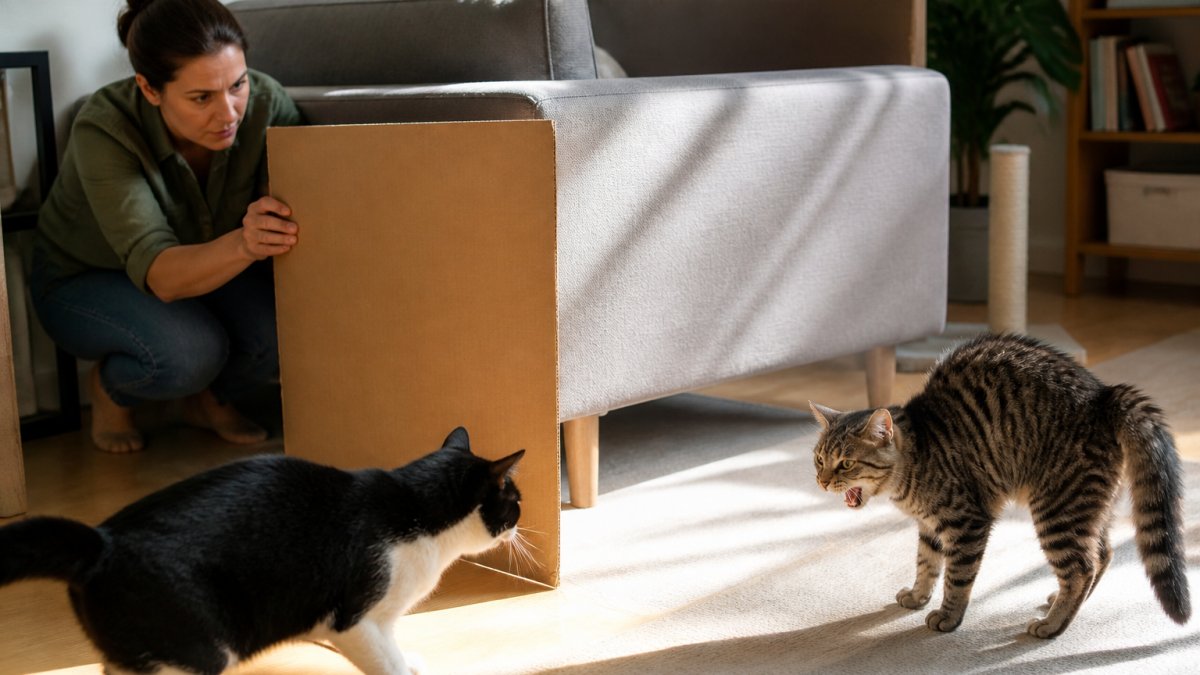
- A visual barrier. Slide a large flattened cardboard box, a cookie sheet, or a thick blanket between them. This blocks the line of sight without you reaching in.
- A soft spray of water near, not at, the cats. Aim at the floor between them. Direct spraying can escalate arousal.
- Dim the lights. If the fight continues, kill the overhead light. Cats rely on visual cues, and darkness often breaks the lock.
- A towel drop. Drop a heavy bath towel over one cat to disorient it long enough for the other to escape.
Once they separate, do not pick either cat up right away. A cat still in fight mode can redirect onto you. Give them 10 to 15 minutes in separate rooms to come down.
What to Do If There Are Injuries
Check both cats head to tail after any fight, even one that looked minor. Cat bites are puncture wounds that seal over quickly and trap bacteria under the skin, so the surface can look fine while an abscess forms underneath.
Look for:
- Small puncture marks, often on the head, neck, or front legs
- Swelling, warmth, or a squishy lump under the skin
- Limping, favoring a leg, or reluctance to jump
- Squinting, pawing at the face, or a cloudy eye
- Bleeding that doesn't stop within a few minutes
- Hiding, refusing food, or a sudden fever (warm ears, lethargy)
Call your vet the same day if you see any puncture wound, swelling, limping, or eye involvement. Bites near the eye, throat, or chest are urgent, go in right away. Abscesses can develop within 24 to 72 hours, and a bite that looks tiny on day one can be a golf-ball-sized infection by day three.
The First 60 Seconds Matter Most
What you do immediately after a fight sets the tone for the next 24 to 48 hours. Separate the cats into different rooms with the doors closed. Do not try to reintroduce them the same day. Do not comfort one cat in front of the other, that can reinforce tension. Feed them on opposite sides of a closed door within an hour if both will eat, which starts the calming association early.
If either cat is panting, drooling, or pacing long after the fight ends, that's a stress response that needs a vet call, not just quiet time.
How Long to Keep Cats Separated After a Fight
Keep cats separated for at least 24 to 48 hours after a serious fight, and longer if either cat is still hissing at the door. There is no fixed rule, because every pair is different.
Use that time to reset the environment. Feed them on opposite sides of a closed door, and rotate who gets free time in the main rooms.
Signs it's too soon to reunite:
- Either cat hisses at the closed door
- One cat stops eating or hides
- The other cat paces or guards the door
How to Reintroduce Cats After a Fight
Reintroducing cats after a fight works best when you go slower than you think you need to. Rushing the process is the most common reason fights start again.
Follow this staged plan:
| Stage | What to Do | Move On When |
|---|---|---|
| 1. Scent swap | Rub a cloth on each cat, swap cloths | Both cats sniff calmly |
| 2. Door feeding | Feed on opposite sides of a closed door | Both eat without hissing |
| 3. Visual contact | Crack the door or use a baby gate | Both stay calm for 5+ minutes |
| 4. Supervised time | Same room, short sessions, treats ready | No staring or stalking |
| 5. Full access | Longer sessions, then free roam | Two calm weeks in a row |
Scent Swapping and Visual Contact
Scent swapping is the quiet step most people skip. It teaches each cat that the other's smell means good things, like food and treats.
Visual contact should be brief at first. Use a baby gate or a cracked door so they can see each other without touching. Pair every session with food rewards so both cats link the other's presence with something positive.
Setting Up Your Home to Prevent Future Fights
Resource distribution matters more than most people realize. Cats fight over food, litter, and high perches far more often than over affection.
Set up your home with these rules:
- One litter box per cat, plus one extra
- Separate feeding areas in different rooms
- Multiple water bowls away from food
- Vertical space like cat trees and shelves
- At least two escape routes in every room
- Pheromone diffusers in shared spaces
A well-placed cat tree gives both cats their own perch, which cuts down on staring contests. Our enrichment toys also help burn off the restless energy that fuels tension.
What to Do When Aggression Returns or Progress Stalls
Aggression that comes back after weeks of calm usually means something in the environment changed. A new piece of furniture, a move, a guest, or even a seasonal shift can restart the cycle.
Start over at scent swapping. Do not punish either cat, and do not yell. Punishment makes fear worse and can turn stress into a long-term behavior problem.
If fights keep happening after two or three full reintroduction attempts, talk to your vet. A vet can rule out pain, thyroid issues, or other medical causes.
We stock calming beds, puzzle feeders, and enrichment toys that support the environment changes your vet or behaviorist may recommend.
Frequently Asked Questions
How do I safely break up a cat fight?
Never use your hands or yell. Make a loud noise like clapping or a whistle to startle them apart. If that fails, slide a large piece of cardboard or a thick blanket between them. Once separated, keep them in different rooms. Check for injuries and call your vet if you see puncture wounds, limping, or bleeding.
How long should I keep my cats separated after a fight?
Keep them separated for at least 24 to 48 hours, but some cats need a week or longer. Watch for calm behavior through a cracked door or baby gate. If they hiss or swat, extend the separation. Rushing this step often leads to another fight. Always provide separate food, water, litter boxes, and resting spots during this time.
Will my cats ever get along after fighting?
Many cats learn to tolerate each other with a slow reintroduction. Start with scent swapping, then visual contact through a gate, and finally supervised time together. Use food rewards and play to create positive associations. If aggression continues after several weeks, consult your veterinarian or a certified cat behavior consultant.
When should I contact a veterinarian or cat behavior professional?
Call your vet if you see deep bites, bleeding, limping, or a cat that hides and refuses food. Also seek help if aggression escalates despite separation and reintroduction, or if either cat shows signs of fear, anxiety, or redirected aggression. A professional can rule out medical causes and create a behavior plan.
Fights after an introduction are stressful, but they are not permanent. With patience, the right setup, and a slow reintroduction, most cats learn to share space again. FurEver Finds can help you build that calm home with premium enrichment toys, cozy cat furniture, and calming products chosen for quality you can trust. Get started with FurEver Finds and give both cats the comfort and space they need to settle in.