


Premium Pet Enrichment Toys for Dogs: 2026 Guide
Table of Contents
- Why Premium Enrichment Toys Matter for Dogs
- Mental Stimulation for Dogs: The Science Behind Play
-
Top Premium Enrichment Toys Compared
- KONG Classic: Durable Foundation for Treat Dispensing
- West Paw Toppl: Customizable Puzzle Feeding
- Nina Ottosson Dog Tornado: Multi-Layer Problem Solving
- LickiMat: Calming Enrichment for Anxious Dogs
- Planet Dog Orbee-Tuff Snoop: Translucent Treat Challenge
- Nina Ottosson Hide N' Slide: Advanced Puzzle Game
- Flirt Pole: Prey Drive Activation
- Wobble Wag Giggle Ball: Sound-Activated Engagement
- How to Use Enrichment Toys: Strategies That Work
- Choosing the Right Toy for Your Dog's Age and Size
- Toy Rotation and Long-Term Enrichment Planning
- Conclusion
Last Updated: August 14, 2026
Premium pet enrichment toys for dogs build cognitive resilience, manage anxiety, and prevent destructive behaviors stemming from boredom. At FurEver Finds, we've seen how the right enrichment toys transform a dog's daily life, reducing stress-related chewing, excessive barking, and restless energy. This guide breaks down the science behind mental stimulation, compares the best premium options, and provides a framework for choosing toys based on your dog's age, size, and behavioral needs.
An enriched dog sleeps better, exhibits fewer behavioral problems, and forms stronger bonds with their owners.
Why Premium Enrichment Toys Matter for Dogs
Dogs are problem-solvers by nature. In the wild, they spend hours foraging and hunting, forms of mental work that keep their brains sharp. Without intentional enrichment, that cognitive drive redirects into destructive outlets: shredded furniture, obsessive licking, fence running, or excessive barking.
Premium enrichment toys engage the same neural pathways that foraging and hunting activate, providing what behaviorists call "mental fatigue", a state where the dog's brain actively problem-solves rather than spiraling into anxiety or boredom. A mentally fatigued dog is calmer, more focused, and significantly less likely to develop behavioral issues.
Premium toys are built from non-toxic, durable materials designed to withstand repeated use, freezing, and aggressive chewing. They're engineered with specific behavioral goals: some activate prey drive, others promote calm through licking, still others challenge problem-solving abilities.
Mental Stimulation for Dogs: The Science Behind Play
When a dog engages with a puzzle feeder or treat-dispensing toy, their brain releases dopamine, the same neurotransmitter activated by physical exercise. A 20-minute puzzle session can tire a dog as much as a 45-minute walk.
The cognitive work involved in solving enrichment challenges strengthens neural pathways associated with focus, impulse control, and problem-solving. Different enrichment types activate different cognitive processes: puzzle feeders require sequential problem-solving, treat-dispensing toys activate foraging behavior, flirt poles tap into prey drive, and licking-based enrichment triggers a parasympathetic response that calms anxious dogs.
Top Premium Enrichment Toys Compared
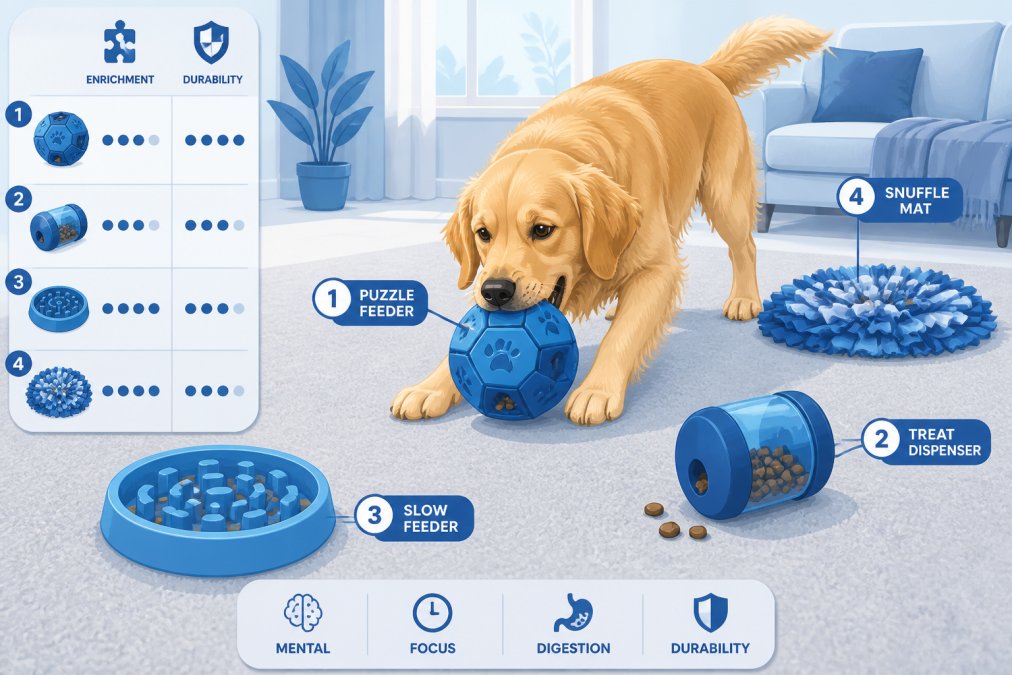
KONG Classic: Durable Foundation for Treat Dispensing
The KONG Classic remains the gold standard. This hollow toy accepts treats, kibble, peanut butter, or wet food. Stuff it, freeze it, bounce it, or fetch with it. The natural rubber construction holds up to serious chewing without splintering. Freezing extends play sessions to 30+ minutes. Veterinarians recommend it because it's been tested across millions of dogs over decades.
The KONG Classic isn't a puzzle toy requiring problem-solving, just determination. For highly intelligent dogs, it may be insufficient.
Best for: Dogs of all ages and sizes, especially those new to treat-dispensing enrichment.
West Paw Toppl: Customizable Puzzle Feeding
The West Paw Toppl offers a customizable system. Multiple sizes interlock, allowing you to create varying difficulty levels by stacking them differently. Fill with wet food, kibble, or treats, then freeze for extended engagement.
The Zogoflex material is non-toxic and recyclable. Freezing transforms this into a long-lasting calming tool, especially valuable for anxious dogs. Top-rack dishwasher safe means realistic cleanup.
Not designed for power chewers. Pricing is higher than the KONG Classic.
Best for: Dogs needing puzzle feeding combined with calming enrichment, particularly those benefiting from frozen treats for anxiety management.
| Toy | Best For | Durability | Freezer-Safe | Puzzle Difficulty |
|---|---|---|---|---|
| KONG Classic | All dogs, treat dispensing | High | Yes | Low |
| West Paw Toppl | Puzzle feeders, anxiety | High | Yes | Medium |
| Nina Ottosson Tornado | Problem-solving focus | Medium | No | Medium-High |
| LickiMat | Calming, anxiety | Medium | Yes | N/A |
| Planet Dog Snoop | Fast eaters, treat challenge | High | No | Medium |
Nina Ottosson Dog Tornado: Multi-Layer Problem Solving
The Nina Ottosson Dog Tornado features three tiers with twelve compartments forcing genuine problem-solving. The dog must spin layers, lift sections, and work through a sequence of actions to access treats. This requires actual cognition.
The difficulty level is genuinely intermediate, challenging enough to engage a smart dog but not frustratingly complex for beginners. Made from food-safe materials free of BPA, PVC, and phthalates.
Not suitable for aggressive chewers. Requires supervision.
Best for: Dogs with intermediate puzzle experience or high intelligence needing genuine cognitive challenge.
LickiMat: Calming Enrichment for Anxious Dogs
LickiMat activates calming through repetitive licking behavior. Spread peanut butter, yogurt, or wet food across the textured surface, freeze it, and watch your dog enter focused calm. The licking action triggers parasympathetic nervous system activation, essentially the opposite of anxiety.
For anxious dogs, separation anxiety, or stress-related behaviors, this is remarkably effective. Freezing extends engagement. Dishwasher safe and affordable.
Not suitable for dogs prone to destroying toys through aggressive chewing.
Best for: Anxious dogs, dogs with separation anxiety, or situations requiring calm.
Planet Dog Orbee-Tuff Snoop: Translucent Treat Challenge
The Planet Dog Orbee-Tuff Snoop is a deceptively simple toy with genuine depth. The translucent squishy construction lets your dog see treats inside but makes extraction challenging. Made in the USA from non-toxic Orbee-Tuff TPE material, free of BPA, lead, and phthalates.
The visual aspect, seeing the treat but having to work for it, creates genuine engagement. The squishy construction is forgiving on teeth while providing resistance. Affordable and durable for most chewing styles.
Not a traditional puzzle toy. Requires supervision with aggressive chewers.
Best for: Dogs enjoying interactive treat challenges needing mental stimulation without complex puzzle mechanics.
Nina Ottosson Hide N' Slide: Advanced Puzzle Game
The Hide N' Slide represents the advanced puzzle spectrum. Two types of hiding spots, swiveling flippers and sliding blocks, require different problem-solving approaches. This demands genuine cognitive engagement and persistence.
The dual-mechanism design keeps engagement fresh. Made from food-safe materials free of harmful chemicals. Durable composite wood construction engages problem-solving at an advanced level.
Requires supervision. Not suitable for power chewers or dogs prone to ingesting foreign objects.
Best for: Dogs that have mastered intermediate puzzles and need genuine cognitive challenge.
Flirt Pole: Prey Drive Activation
The flirt pole taps directly into prey drive. A long pole with a lure on a rope creates chase-and-catch dynamics that activate the same neural pathways as hunting. This is high-intensity mental and physical engagement compressed into short bursts.
For high-energy dogs and those with strong prey drive, this is exceptionally effective. Provides intense mental engagement in a small space. Short sessions (10-15 minutes) provide equivalent mental fatigue to longer fetch sessions.
Requires active owner participation. Not suitable for dogs with low prey drive.
Best for: High-energy dogs, dogs with strong prey drive, and those needing impulse control training.
Wobble Wag Giggle Ball: Sound-Activated Engagement
The Wobble Wag Giggle Ball operates on simple principles: internal tubes emit giggle sounds when the ball rolls or gets shaken. No batteries, no complexity. Six clutch pockets make it easy for dogs to grab and carry.
Dogs are naturally curious about the giggle sounds. The unpredictability of when sounds trigger keeps engagement fresh. No batteries means no ongoing costs. Durable for most play styles.
The constant giggling can be irritating to owners. Not a puzzle toy, purely interactive play.
Best for: Dogs motivated by sound and novelty, particularly those enjoying fetch and interactive play.
How to Use Enrichment Toys: Strategies That Work
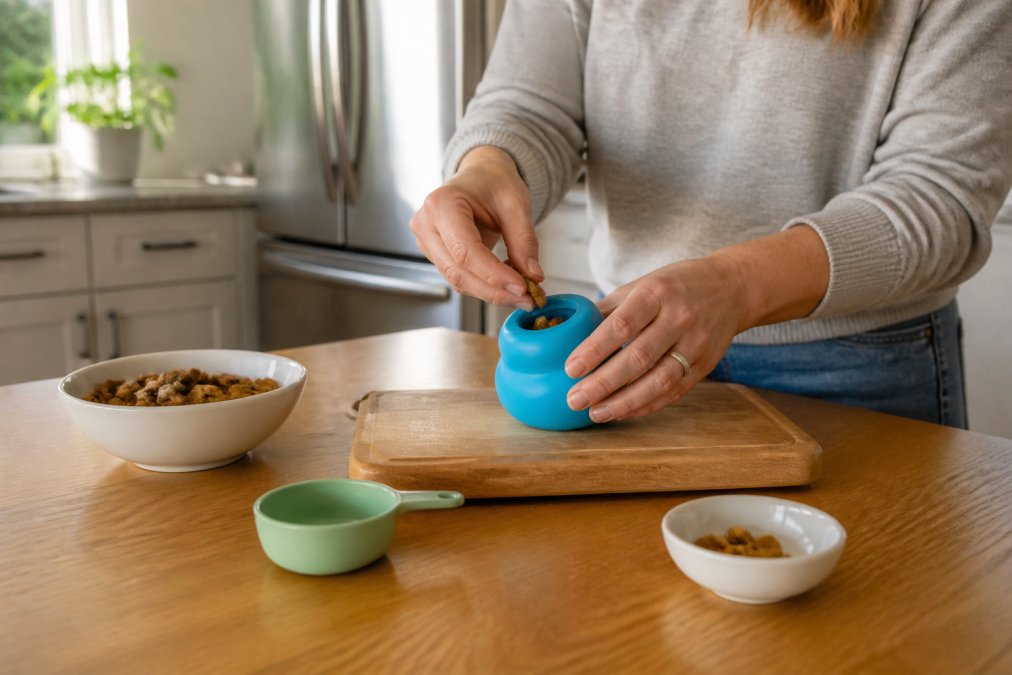
Simply buying a premium enrichment toy doesn't guarantee success. Combine multiple approaches: rotation, difficulty progression, and strategic deployment based on your dog's emotional state.
Start with the right difficulty level. A toy that's too easy becomes boring within days. A toy that's too hard becomes frustrating. If your dog is new to puzzle toys, start with something straightforward like the KONG Classic or Planet Dog Snoop. Once they've mastered the mechanics, progress to the Nina Ottosson Tornado or Hide N' Slide.
Freeze everything that can be frozen. Freezing extends play sessions dramatically. A KONG stuffed with peanut butter and kibble, then frozen, can occupy a dog for 30-45 minutes instead of 5-10. Wet food frozen in a West Paw Toppl becomes a multi-sensory calming experience.
Use enrichment toys strategically for anxiety management. Deploy calming toys like LickiMat or frozen treat-dispensers when anxiety is manageable but present. The focused engagement helps redirect anxious energy into problem-solving.
Rotate toys on a monthly schedule. A toy loses novelty within 2-3 weeks of constant availability. Store toys in rotation, keep 3-4 available at any time, rotate them monthly, and reintroduce retired toys after 4-6 weeks.
Pair enrichment with training. Use puzzle toys as rewards during training sessions. This builds positive association with problem-solving and reinforces that mental work leads to rewards.
Supervise initially, then adjust. When first introducing a new toy, supervise your dog's interaction. Once confident the toy is appropriate, allow unsupervised play.
Choosing the Right Toy for Your Dog's Age and Size
Age and size dramatically affect which enrichment toys are appropriate.
Puppies (8 weeks to 6 months): Avoid small toys that could be swallowed. Start with large, durable options like the KONG Classic in the appropriate size. Avoid complex puzzles; puppies lack patience and problem-solving experience. LickiMat can be valuable for teething relief when frozen.
Young dogs (6 months to 3 years): This is the peak energy and intelligence phase. Young dogs can handle complex puzzle toys and benefit from high-intensity engagement like flirt poles. Introduce a variety of enrichment types: puzzle feeders, treat-dispensers, interactive toys, and prey-drive activators.
Adult dogs (3 to 7 years): Tailor enrichment to their individual personality. High-intelligence dogs need genuinely challenging puzzles. Anxious dogs benefit from calming enrichment. High-energy breeds need prey-drive activation.
Senior dogs (7+ years): Avoid toys requiring jumping or intense physical activity. Focus on low-impact enrichment: gentle puzzle toys, treat-dispensers not requiring aggressive chewing, and calming toys. LickiMat is excellent for seniors because it provides engagement without physical demand.
By size and chewing intensity:
Small dogs (under 15 lbs) need toys they can manipulate. The KONG Classic comes in extra-small sizes. LickiMat offers small options. Avoid toys with small parts that could be swallowed.
Medium dogs (15-50 lbs) have the most toy options. Most premium enrichment toys are designed for this range.
Large dogs (50+ lbs) need durable construction and appropriately sized toys. The KONG Classic in large or extra-large sizes handles their chewing power.
Power chewers need reinforced options: KONG Extreme (not Classic), durable rubber toys, and heavy-duty materials. Focus on toys designed for aggressive chewing rather than sophisticated puzzles.
Toy Rotation and Long-Term Enrichment Planning
The most sophisticated enrichment strategy maximizes engagement through rotation. A toy that's boring after constant use becomes novel again after 4-6 weeks in storage.
The rotation system: Maintain a collection of 8-12 toys across different categories. Keep 3-4 available at any time. Every 2-4 weeks, rotate them. Store retired toys where your dog can't see them. When you reintroduce a toy after 4-6 weeks, it feels new again.
Categorize by type: Organize your collection by enrichment category: treat-dispensers, puzzle toys, calming toys, interactive toys, and prey-drive toys. This makes it easier to rotate strategically based on your dog's current needs.
Track what works: Every dog has preferences. Keep mental notes about which toys your dog engages with most. Prioritize those in your rotation.
Seasonal adjustments: Winter might call for more indoor enrichment toys. Summer might emphasize outdoor interactive play like flirt poles. Adjust your rotation based on seasonal activity levels.
Long-term planning: Premium enrichment toys are investments. A quality KONG or West Paw Toppl lasts years with proper care. Start with 3-4 foundational toys in different categories, then add 1-2 toys quarterly as budget allows. Within a year, you'll have a strong rotation system.
FurEver Finds offers a curated selection of premium enrichment toys specifically designed for long-term engagement strategy. Each toy is selected for durability, safety, and genuine enrichment value.
The difference between a dog that's mentally engaged and one that's chronically under-stimulated is profound. Destructive chewing, excessive barking, anxiety, and behavioral problems often stem not from bad temperament but from unstimulated minds. Premium pet enrichment toys for dogs address this at the root.
FurEver Finds offers a thoughtfully curated selection of premium enrichment toys chosen specifically for their durability, safety, and genuine enrichment value. Each toy serves a distinct purpose, from treat-dispensing to puzzle-solving to calming, ensuring you can build a rotation system tailored to your dog's age, size, and behavioral needs. With next-day delivery for orders placed by noon, you can start enriching your dog's life today. Shop with confidence knowing that every item is selected for quality you can trust.
Frequently Asked Questions
What makes a dog toy considered premium?
Premium enrichment toys combine durable, non-toxic materials (BPA-free, phthalate-free) with thoughtful design that engages multiple senses. They withstand regular use without breaking apart, offer varied difficulty levels for mental engagement, and are often backed by veterinary or behavioral science. Premium toys prioritize your dog's safety and cognitive development over cheap materials or short-lived gimmicks.
How much mental stimulation for dogs is enough?
Most dogs benefit from 15-30 minutes of active mental stimulation daily, broken into multiple sessions. This can be puzzle toys, treat-dispensing challenges, or interactive games. Mental fatigue is as important as physical exercise. Younger and high-energy dogs may need more; senior dogs may need less. Rotate toys every few days to maintain novelty and prevent boredom.
Can enrichment toys really help with separation anxiety?
Yes. Toys that encourage licking (like LickiMat) and problem-solving puzzles create calming activities that redirect anxious energy. The mental focus required to solve a puzzle or work through a treat-dispensing toy can reduce stress behaviors. Freezing treats in toys extends engagement time, making them especially useful during periods when your dog is alone.
How do I choose the right enrichment toy for my dog's size?
Match toy size to your dog's mouth and chewing strength. Small dogs (under 20 lbs) do well with compact puzzles and soft-textured mats. Medium dogs (20-60 lbs) handle standard-sized treat dispensers and moderate-difficulty puzzles. Large and power chewers need reinforced rubber toys or heavy-duty puzzle designs. Always supervise play and inspect toys regularly for damage.
Are premium enrichment toys worth the investment?
Premium toys cost more upfront but last significantly longer and are safer. They're designed by behavioral scientists to genuinely engage your dog's problem-solving skills, reducing destructive behavior, anxiety, and boredom-related health issues. The durability means fewer replacements, and the mental enrichment benefits your dog's long-term happiness and behavior.
This article was written using GrandRanker