


Puppy Socialization Guide for Beginners: A 2026 Plan
Table of Contents
- Why Puppy Socialization Decides Your Dog's Future Behavior
- Your Puppy Socialization Timeline, Week by Week
- The Beginner's Puppy Socialization Checklist
- How to Socialize a Puppy Safely Before Vaccines Are Complete
- Puppy Socialization Games That Build Confidence
- Socializing Shy, Reactive, or Breed-Specific Puppies
- Conclusion: Keep Socializing Past Puppyhood
- Frequently Asked Questions
Last Updated: September 24, 2026
Why Puppy Socialization Decides Your Dog's Future Behavior
Puppy socialization is the deliberate process of introducing a young dog to new people, animals, sounds, surfaces, and environments during its first months so it grows into a calm, confident adult. Get it right and you prevent most of the fear and aggression problems that fill shelters; get it wrong and you spend years managing a dog that panics at the doorbell.
The Critical Window: 3 to 14 Weeks
The critical socialization window runs from roughly 3 to 14 weeks, when a puppy's brain absorbs new experiences with far less fear than it will later. Most veterinary behaviorists consider it the single most important developmental phase in a dog's life.
What Happens When You Skip It
A puppy that misses this window tends to grow into an adult that reacts to novelty with suspicion rather than curiosity, a dog never given the chance to learn the world is safe.
Your Puppy Socialization Timeline, Week by Week
A puppy socialization timeline keeps you from guessing what to do next. The goal is steady, low-pressure exposure, not a packed calendar.
| Age | Focus | Daily Target |
|---|---|---|
| 3-5 weeks | Gentle handling at the breeder | Breeder-led |
| 6-8 weeks | Home sounds, new surfaces | 3-4 short sessions |
| 9-12 weeks | People, safe dogs, car rides | 4-5 new things |
| 13-16 weeks | Public spaces, novel stimuli | 5+ exposures |
| 4-6 months | Reinforcement and variety | Ongoing |
Adolescence: The Second Window (6 to 18 Months)
A second fear period often arrives between 6 and 18 months. A puppy that seemed bombproof at four months may suddenly shy away from things it once ignored.
The Beginner's Puppy Socialization Checklist
A puppy socialization checklist turns a vague goal into daily action. Work through the categories below at your puppy's pace.
People, Places, Sounds, and Surfaces
- Meet 5 different people weekly (ages, appearances, hats, uniforms)
- Visit a quiet parking lot or park entrance
- Hear vacuum, thunder recordings, and doorbell sounds
- Walk on grass, tile, gravel, and metal grates
- Ride in the car for short, calm trips
Handling Exercises and Alone Time
- Touch paws, ears, and mouth gently
- Practice gentle restraint for a few seconds
- Feed meals in a crate with the door open
- Leave the room briefly and return calmly
- Introduce a puzzle feeder for solo enrichment
Handling exercises build the tolerance your vet will thank you for. Alone time prevents separation distress from taking root.
How to Socialize a Puppy Safely Before Vaccines Are Complete
You can socialize a puppy before its vaccine series finishes by choosing low-risk environments and carrying your puppy in your arms where unknown dogs roam. The American Veterinary Society of Animal Behavior position is that the risk of behavior problems from under-socialization often outweighs the disease risk of careful early exposure, but "careful" is doing a lot of work in that sentence, so here is what it actually means in practice.
Think in Risk Tiers, Not a Yes/No Rule
Most veterinarians and trainers sort exposures into three tiers based on where your puppy's feet and nose go, not whether your puppy leaves the house.
Tier 1, lowest risk, start immediately (7-8 weeks onward):
- Your own yard or a private yard with no unknown-dog traffic
- Carrying your puppy in your arms through a parking lot, hardware store entrance, or farmers market
- A friend's or family member's home with a healthy, fully vaccinated adult dog
- A puppy class that requires proof of at least one DHPP vaccine and sanitizes between sessions
- Sitting on a bench watching traffic, strollers, and pedestrians from your lap
Tier 2, moderate risk, use judgment:
- Quiet sidewalks in your own neighborhood, avoiding yards with resident dogs
- Pet store parking lots (not the floor)
- Vet clinic lobbies for "happy visits" where staff feed treats and no exam happens
- Groomer lobbies, again carried or on a mat you brought
Tier 3, avoid until your veterinarian clears your puppy:
- Dog parks and dog beach areas
- Pet store floors and big-box store floors where unknown dogs walk
- Rest stops, highway travel plazas, and any area with heavy unknown-dog traffic
- Puppy playgroups that mix unvaccinated litters from different sources
The Vaccine Timeline You're Working Around
A typical core series in the United States runs at roughly 6-8 weeks, 10-12 weeks, and 14-16 weeks, with rabies given separately per state law (commonly at 12-16 weeks). Protection is not complete until one to two weeks after the final dose, so the socialization and vaccination windows overlap almost entirely, which is why the tier system matters more than a blanket "wait until fully vaccinated" rule.
What to Bring and What to Do
- Carry a mat or towel so your puppy has a clean, familiar surface to sit on
- Bring high-value treats (small, soft, eaten in one bite) and a treat pouch
- Keep sessions to 5-10 minutes and end before your puppy gets tired
- Wipe paws with pet-safe wipes after any Tier 2 exposure
- Log what you did each day so you can spot gaps in your exposure list
Reading Fear, Overstimulation, and Trigger Stacking
Canine body language tells you when to stop: watch for tucked tails, whale eye (whites of the eyes showing), lip licking, yawning, freezing, and sudden ground-sniffing as a displacement behavior.
The Vet-Conversation Script
Before your first outing, ask your veterinarian three questions:
- "Is my puppy current enough on vaccines to attend a sanitized puppy class?"
- "Which venues in our area do you consider Tier 3 right now?"
- "When can we schedule a happy visit so my puppy meets you without an exam?"
Getting those answers in writing (even a portal message) gives you a defensible plan and a record if anything goes wrong.
Puppy Socialization Games That Build Confidence
Puppy socialization games turn exposure into play, which is how puppies learn best. Confidence builds when a puppy chooses to investigate something new and gets rewarded for it.
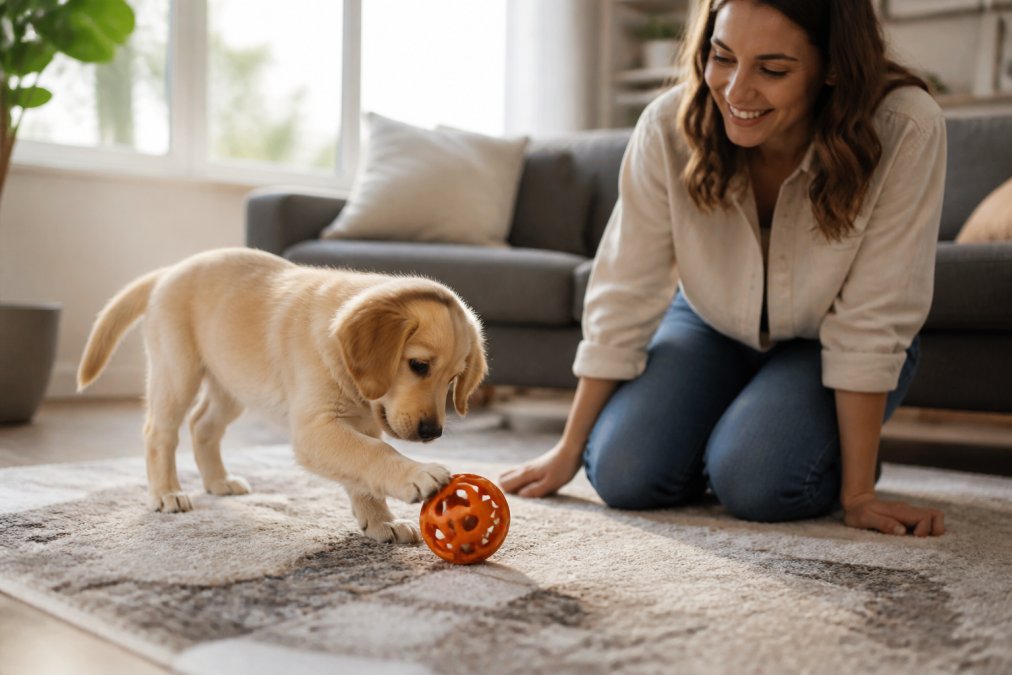
Positive Reinforcement, Desensitization, and Counter-Conditioning
Positive reinforcement means rewarding the behavior you want the moment it happens. Desensitization means starting with a tiny version of a scary thing, like a distant sound, and gradually increasing it.
Socializing Shy, Reactive, or Breed-Specific Puppies
Most guides assume a confident, middle-of-the-road puppy. Many beginners don't have one. If your puppy hides behind your legs, barks at strangers, or comes from a breed with strong genetic drives, the standard checklist needs a Plan B.
Interactive Puzzle Ball – Fun-Filled →
Plan B for the Shy Puppy
A shy puppy is not broken, its fear threshold is simply lower, so your job is to keep every exposure under that threshold rather than pushing through it.
The distance-and-treat protocol:
- Find the distance at which your puppy will still take a treat and look at the trigger without freezing. That distance is your starting line, it might be 50 feet from a stranger, or across the street from a dog.
- Mark and reward every voluntary glance at the trigger. You are teaching "see scary thing → treat appears."
- When your puppy looks at the trigger, then back at you, then takes the treat three times in a row, close the distance by a few steps.
- If your puppy stops eating, you moved too fast. Back up and repeat.
Plan B for the Reactive Puppy
Reactive means the puppy reacts, barking, lunging, growling, usually because it's scared, not dominant. The mechanics match the shy protocol, but distances are longer and treats need to be higher value (boiled chicken or cheese, not kibble).
A few rules that matter:
- Never correct the growl. The growl is information. Suppressing it removes your warning system and leaves you with a dog that bites without warning.
- Work below threshold, always. If your puppy is barking, you are too close. There is no learning happening in that moment.
- Use a front-clip harness or a well-fitted martingale, not a choke or prong collar, during this work. Pain adds stress to an already stressed dog.
- Consider a certified trainer. For reactivity that shows up before 16 weeks, a few sessions with a trainer who uses force-free methods can save you a year of guessing.
Breed-Specific Nuances That Actually Change Your Plan
Breed groups were developed for specific jobs, and those jobs shape what a puppy finds rewarding, scary, or distracting. Generic advice often misses this.
Herding breeds (Border Collies, Australian Shepherds, Corgis):
- Often reactive to fast-moving objects, bikes, skateboards, running children, cars
- Need early, calm exposure to motion, with rewards for looking at you instead of chasing
- Benefit from impulse-control games (wait, leave it, settle on a mat) more than from more exposure
Guardian breeds (Great Pyrenees, Akitas, Rottweilers):
- Genetically inclined to be wary of strangers, especially after 12 weeks
- Need many low-pressure introductions to visitors, with the visitor ignoring the puppy and letting it approach
- Benefit from a "place" cue so they learn to settle while guests move around
Terriers and scent hounds:
- Driven by prey and smell, which means a squirrel or a scent trail can override your treats
- Need reinforcement that competes with the environment, real meat, not biscuits
- Benefit from sniff-based enrichment as a socialization tool, not just a reward
Toy breeds:
- Frequently over-handled by strangers, which can create a defensive adult
- Need a rule that strangers do not pet without your permission and the puppy's willingness
- Benefit from being walked on the ground (once cleared) rather than carried everywhere, so they learn to navigate the world
High-drive working breeds (Malinois, German Shepherds, Labs):
- Need structured outlets for energy or socialization sessions turn into over-arousal
- Benefit from a "work then settle" rhythm: 5 minutes of training, then 10 minutes of calm chewing or mat time
Urban vs. Rural: Two Different Plans
Where you live changes what your puppy needs exposure to, and most guides assume a suburban middle.
Post-Socialization Maintenance: The Part Everyone Skips
Socialization does not end at 16 weeks. A second fear period commonly arrives between 6 and 18 months, when a puppy that seemed bombproof at four months may suddenly shy away from things it once ignored, normal, and not a sign you failed.
During adolescence:
- Keep doing short, positive exposures to the categories your puppy already knows
- Scale back to easier versions when fear reappears, then rebuild
- Avoid forcing interactions with people or dogs your puppy avoids
- Continue rewarding calm behavior in new places, not just at home
Conclusion: Keep Socializing Past Puppyhood
Socialization doesn't end at sixteen weeks, the part most beginners miss. The skills you build early need reinforcement through adolescence and beyond, or they fade.
Frequently Asked Questions
What is the 3-3-3 rule for puppies?
The 3-3-3 rule describes how a rescue or new puppy typically settles in: three days to decompress and feel safe, three weeks to learn your routine and start showing personality, and three months to feel fully at home. It is a settling-in guideline, not a socialization schedule. Keep introductions low-key during the first three days, then layer in gentle puppy socialization outings once your puppy is eating, sleeping, and relaxing around you.
Is 20 weeks too late to socialize a puppy?
Twenty weeks is past the peak critical period, but it is not a deadline. The fear period around 8 to 12 weeks and the window closing near 14 to 16 weeks mean early exposure matters most, yet puppies and adolescent dogs keep learning through positive reinforcement and gradual exposure. Go slower, keep sessions short, and pair every new person, sound, or surface with treats so the experience stays positive.
How do I socialize my puppy before vaccinations are complete?
Use safe environments and controlled introductions instead of dog parks. Carry your puppy through the neighborhood, host visitors at home, roll a shopping cart past them from a distance, and set up playdates with healthy, vaccinated adult dogs in a private yard. Pair each new experience with treats, keep sessions under 10 minutes, and track progress on a puppy socialization checklist so you cover people, sounds, surfaces, and handling without overwhelming your puppy.
How do I know if my puppy is overstimulated during socialization?
Watch canine body language: lip licking, yawning, tucked tail, whale eye, freezing, or sudden zoomies are early signs that your puppy has had enough. Trigger stacking, where several small stressors pile up in one outing, makes overstimulation more likely. End the session calmly, move to a quiet space, and let your puppy rest. Short, frequent outings beat long, crowded ones every time.
What are the best puppy socialization games for beginners?
Try the name-and-treat game, pass-the-puppy with calm friends, a treat scatter on new surfaces like grass or gravel, and a puzzle feeder that rewards problem solving. A durable tug rope also works well for building cooperative play and impulse control. Keep rounds to two or three minutes, end on a win, and always follow with rest so your puppy's social skills grow without stress.