


Sudden Anxiety in Senior Dogs: Causes & Relief
Table of Contents
- Why Senior Dogs Develop Anxiety Out of Nowhere
- Recognizing the Signs of Cognitive Dysfunction in Dogs
- Physical Health Triggers: Pain, Sensory Loss, and Medical Conditions
- How to Calm an Anxious Senior Dog at Night
- Natural Anxiety Relief for Senior Dogs
- When to See a Vet and What Tests to Expect
- Conclusion
- Frequently Asked Questions
Last Updated: September 27, 2026
Why Senior Dogs Develop Anxiety Out of Nowhere
Sudden anxiety in senior dogs rarely appears without a physical or neurological trigger. At FurEver Finds, owners describe calm dogs that turned restless overnight, and in most cases the cause is measurable: pain, sensory loss, or changes in brain function.
How Aging Changes Your Dog's Brain and Body
Aging alters the brain and body at once: brain chemistry shifts, neuron function slows, and the senses send weaker signals.
Recognizing the Signs of Cognitive Dysfunction in Dogs
The signs of cognitive dysfunction in dogs read like a checklist most owners recognize only in hindsight. Cognitive dysfunction syndrome (CDS) is the canine equivalent of dementia: progressive decline in memory, learning, awareness, and spatial orientation.
Watch for these behavioral changes:
- Disorientation: staring at walls, getting stuck in corners, failing to find the door
- House soiling: accidents indoors despite a previously reliable routine
- Sleep-wake cycle disruption: pacing or vocalization through the night
- Altered interactions: less interest in greetings, or sudden clinginess
- Compulsive disorders: repetitive licking, circling, or staring
Sundowning: When Evening Brings Restlessness
Sundowning is increased agitation, pacing, and vocalization that begins in the late afternoon and worsens into the night. It mirrors sundowning in human dementia and is one of the most distressing symptoms for owners.
Physical Health Triggers: Pain, Sensory Loss, and Medical Conditions
Physical discomfort drives more senior dog anxiety than most owners suspect. Pain is the most common medical trigger, and dogs hide it well until it becomes constant.
Arthritis and Chronic Pain
Arthritic pain shows up as reluctance on stairs, stiffness after rest, and irritability when touched. A dog in chronic pain lives in vigilance, and that vigilance looks exactly like anxiety.
Hearing and Vision Decline
Sensory decline removes the early warning system a dog relies on. A dog that cannot hear you approach startles when you appear; one that cannot see you leave may panic.
How to Calm an Anxious Senior Dog at Night
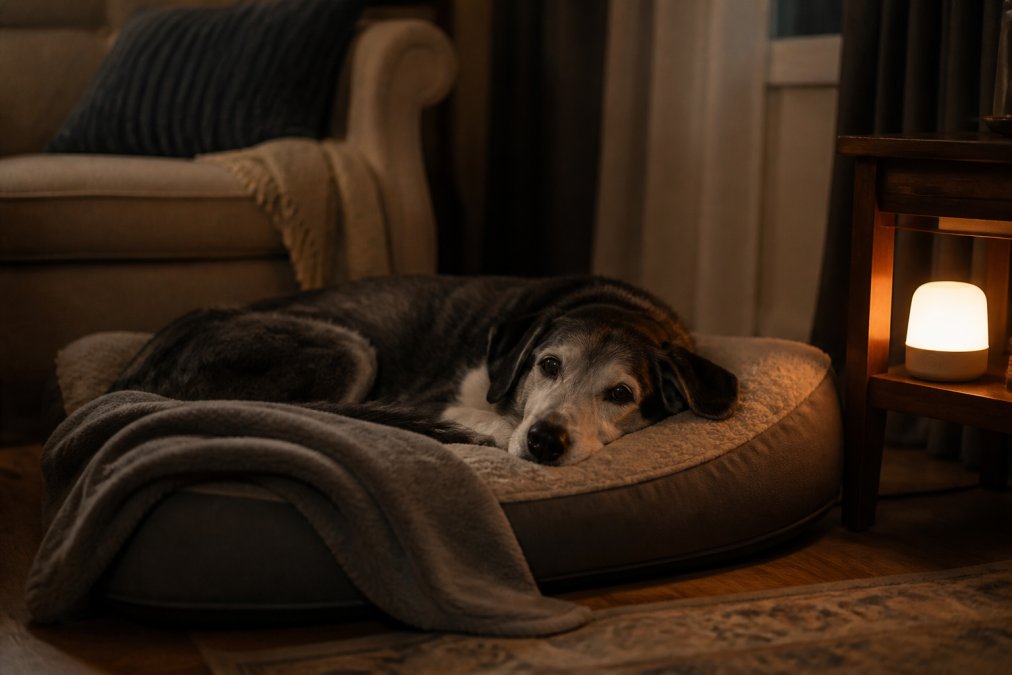
Nighttime anxiety drives most late-night calls to veterinary offices and deserves its own protocol. During the day, a dog has sensory input, activity, and your presence to anchor it. After dark, a dog with failing vision or hearing loses almost all of that at once, and a brain already struggling with cognitive dysfunction has nothing to work with.
Why Nights Are Different
Three mechanisms stack after dark:
- Sensory drop-off. A dog with nuclear sclerosis (the cloudy lens change most seniors develop) sees poorly in low light even if daytime vision seems fine. A dog with presbycusis (age-related hearing loss) also loses the ambient sound cues that told it you were still in the house.
- Sleep-wake cycle disruption. CDS commonly flattens the circadian rhythm, so the dog is awake when it should be sleeping and drowsy during the day.
- Reduced owner activity. You are still, no foot traffic, no kitchen noise, nothing to track. An under-stimulated anxious brain fills the gap with vigilance.
Sundowning is the clinical pattern that results: agitation, pacing, staring, and vocalization that build through the night.
The Evening Protocol
Run this sequence at the same times daily. Predictability is the active ingredient, not any single step.
- Anchor the last meal and last walk to fixed clock times. A dog that knows what happens next has less to monitor.
- Add a short, low-impact enrichment session in the early evening, a sniff walk, scatter feed, or slow puzzle feeder. Mental work tires a senior brain better than physical work without aggravating arthritis.
- Dim the lights gradually starting an hour before bed rather than switching them off. Abrupt darkness removes the last visual information a dog with failing vision was using.
- Place nightlights along the route your dog uses, bedroom to door, bedroom to water bowl. Motion-activated plug-ins work well and cost little to run.
- Keep the sleeping area in the same place every night. Do not move the bed to "where you can watch" the dog; that removes a landmark.
- Offer a comfort object the dog can settle against. The ChewPal CuddleBuddy is a soft plush squeaky toy designed to reduce boredom and separation distress during alone time, useful for a dog that wakes and needs something to orient to.
- Keep your own response flat and boring. If your dog paces and you get up, turn on lights, and talk softly, you have taught it that nighttime distress produces attention. Redirect with a silent, unlit toilet break and return to bed, no play, no conversation, no eye contact.
What Not to Do at Night
- Do not use a bark-control device on a dog with cognitive dysfunction. Tools like the Ultrasonic Dog Bark Trainer work best paired with consistent positive reinforcement, and a confused dog that cannot connect the sound to a behavior will simply become more distressed.
- Do not crate a dog that was never crate-trained. Confinement anxiety in a disoriented senior is worse than free access to a safe room.
- Do not change the sleeping location mid-week hoping it helps. Consistency beats novelty at night.
- Do not withhold water in the evening to reduce overnight accidents. Restricting water can worsen kidney and urinary issues in seniors. Manage accidents with absorbent pads and a mid-night break instead.
When Nighttime Anxiety Needs More Than Routine
If the protocol does not reduce episodes within two to three weeks, or the dog vocalizes for hours, injures itself, or you are not sleeping, that is the threshold for a veterinary conversation about medication. Nighttime distress is a common reason practitioners reach for prescription intervention, because sleep disruption compounds the cognitive problem for the dog and caregiver strain compounds it for you.
Interactive Puzzle Ball – Fun-Filled →


Natural Anxiety Relief for Senior Dogs
Natural anxiety relief for senior dogs works best as a supporting layer, not a replacement for veterinary care. Several low-risk options take the edge off while you and your vet work on the underlying cause.
- Pheromone diffusers: synthetic dog-appeasing pheromones can reduce low-level stress in the home environment
- Environmental enrichment: food-dispensing toys, sniff work, and gentle puzzle feeders keep a senior brain engaged
- Behavior modification: reward-based calming techniques that pair a trigger with something positive
- Physical comfort: orthopedic bedding and warmth for arthritic joints
When to See a Vet and What Tests to Expect
Sudden anxiety in a senior dog is a medical question first, and the appointment is where the differential gets narrowed. Most owners walk in without knowing what the vet is looking for, so the visit produces a diagnosis but not a plan. Here is what happens, what each test rules out, and how the medication decision gets made.
Red Flags That Mean Go Now, Not Next Week
Call for a same-day or next-day appointment if any of these appear alongside the anxiety:
- Sudden disorientation, head pressing, or circling
- A first-ever seizure or collapse
- Vocalizing that does not stop when you are present
- House soiling in a dog that was reliably trained
- Refusing food for more than 24 hours
- Any sign of pain on handling, yelping, guarding a limb, reluctance to rise
What the Vet Will Actually Do
The workup is a diagnosis-of-exclusion process. There is no single test for cognitive dysfunction syndrome, so the vet systematically rules out everything else that produces the same signs.
The Medication vs. Supplement Decision
This is the question owners actually ask. Supplements and prescription medication are not competing options, they sit at different points on the same treatment ladder, and the right rung depends on severity, underlying cause, and how much the dog's quality of life is affected.
Prescription anti-anxiety medication is generally considered when:
- The dog's distress is severe enough to affect sleep, appetite, or safety
- Behavioral and environmental changes have not produced meaningful improvement
- The anxiety is blocking the dog from doing normal things (eating, walking, resting)
- There is a risk of self-injury or injury to people in the household
- The underlying cause is progressive and the goal is quality of life, not cure
Preparing for the Appointment
Bring these to the visit:
- Your two-week behavior log
- A complete list of every medication, supplement, and topical product the dog receives, including doses
- Recent lab work if done elsewhere
- A phone video of the anxious behavior, especially nighttime episodes that will not occur in the exam room
- Your questions written down, including the medication question
The video is worth more than most owners realize. Nighttime pacing, sundowning, and seizure activity are almost impossible to describe accurately and almost impossible to reproduce on demand in a clinic.
Conclusion
Sudden anxiety in a senior dog is a signal, not a personality change, and the sooner it is investigated the more options remain open. Between the veterinary workup and the daily routine at home, the right equipment, supportive bedding, gentle enrichment, and comfort items, helps a confused dog settle.
Frequently Asked Questions
What is the 3-3-3 rule for dogs with anxiety?
The 3-3-3 rule describes how rescue dogs adjust to new homes: three days to decompress, three weeks to settle into routine, and three months to feel fully comfortable. Senior dogs experiencing sudden anxiety often benefit from a similar gradual approach. Give your dog predictable meal times, quiet spaces, and gentle introductions to changes. Rushing adjustments can worsen fear-based responses, especially in dogs with sensory decline or cognitive dysfunction syndrome.
Can cognitive dysfunction cause sudden anxiety in dogs?
Yes. Cognitive dysfunction syndrome (CDS) affects senior dogs much like dementia affects aging humans. As neurological function declines, dogs may experience disorientation, altered sleep-wake cycles, and increased nervous anticipation, particularly at night. This condition often manifests as sundowning, where anxiety spikes in the evening. A veterinary examination can assess CDS and rule out other medical causes before starting behavior modification or pharmacological intervention.
When should I see a vet for my dog's sudden anxiety?
Schedule a veterinary examination if anxiety appears suddenly, disrupts sleep, or comes with pacing, vocalization, house soiling, or disorientation. These behavioral changes often signal underlying physical discomfort such as arthritic pain, sensory impairment, or cognitive decline. Early diagnostic testing can identify treatable conditions. Proactive management with your vet improves quality of life and may reduce the need for long-term anxiolytics.
What natural anxiety relief options work for senior dogs?
Natural anxiety relief for senior dogs includes pheromone diffusers, routine stability, environmental enrichment, and calming techniques like gentle massage or white noise. Puzzle feeders and plush comfort toys can redirect nervous energy during alone time. Always discuss supplements with your vet first, since senior dogs may have organ conditions that interact with certain ingredients. Combining home strategies with professional guidance gives the best results.