


Alternatives to Dog Stairs for Senior Pets
Table of Contents
- Why Senior Dogs Need Alternatives to Dog Stairs
- Dog Ramps for High Beds: A Safer Path to Their Favorite Spot
- Portable Carriers and Strollers for Senior Pet Mobility
- Best Orthopedic Beds for Senior Dogs 2026: Support Where They Rest
- Senior Dog Home Accessibility Tips for Every Room
- How to Train Your Senior Dog to Use a Ramp or Carrier
- Common Mistakes to Avoid When Choosing Mobility Aids
- Frequently Asked Questions
Last Updated: September 12, 2026
Why Senior Dogs Need Alternatives to Dog Stairs
Alternatives to dog stairs for senior pets exist because stairs stop being neutral furniture once a dog ages. This guide from FurEver Finds covers the options that work: ramps, carriers, strollers, and orthopedic rest surfaces. A dog who once bounded onto the bed now hesitates, circles, and sometimes yelps. That hesitation is information.
Joint Health and Arthritis in Aging Dogs
Arthritis is the progressive breakdown of cartilage inside a joint and one of the most common conditions in older dogs (avma.org). Every stair step forces a full range of motion through a painful joint while carrying the dog's entire body weight down.
Two mechanisms are at work: impact, since descending stairs concentrates force through the front limbs, and instability, since a dog with hip dysplasia or weakened hindquarters cannot reliably catch itself if a paw slips.
When Stairs Become Dangerous
A staircase becomes a genuine hazard when any of these appear:
- Your dog pauses at the top and needs encouragement to start down
- You hear nails scrabbling for grip on the treads
- Your dog bunny-hops with both hind legs together
- One limb is favored after a nap or a walk
- Your dog has had a recent surgery or injury
The risk compounds with height. A two-step platform is a nuisance. A bed at knee height is a fall.
Dog Ramps for High Beds: A Safer Path to Their Favorite Spot
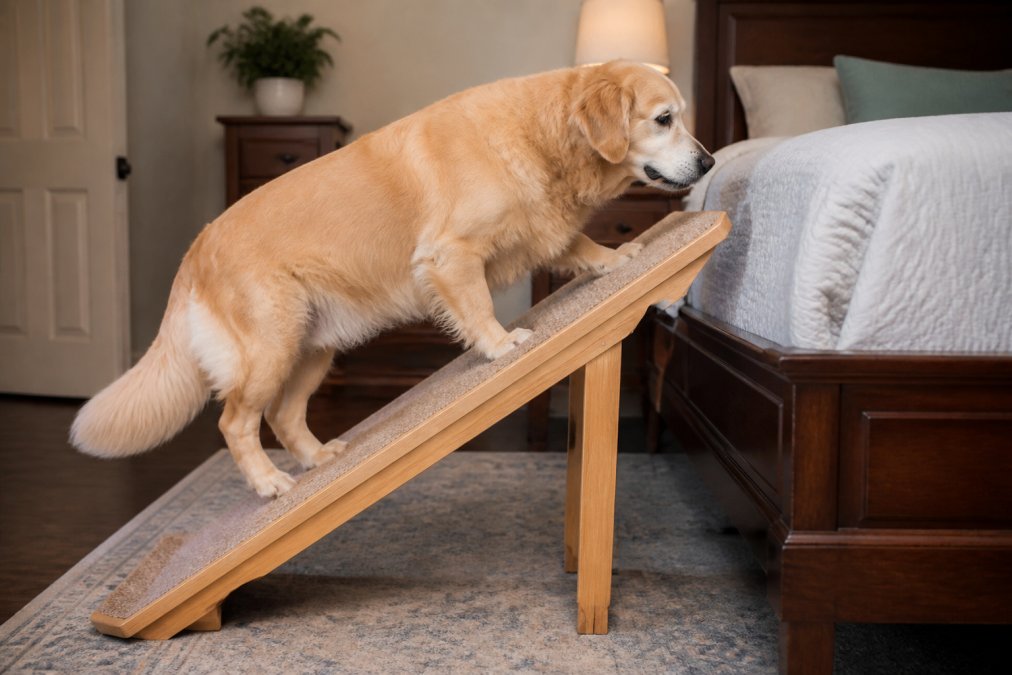
Dog ramps for high beds are the most direct replacement for stairs because they remove the step entirely and replace it with a continuous slope. The trade-off is footprint: a ramp long enough to be gentle takes up floor space. Two specifications decide whether a ramp helps a senior dog: incline angle and walking-surface traction.
Incline Angle: The Number That Decides Everything
Incline angle decides whether a ramp works. A short ramp to a tall bed produces a steep climb harder on joints than the stairs it replaced. A longer ramp flattens the angle and reduces effort per stride.
A useful rule of thumb: for every 1 inch of rise, allow at least 4 to 6 inches of ramp run for a senior or arthritic dog (vcahospitals.com). A bed 24 inches off the floor needs a ramp roughly 8 to 12 feet long. A 3-foot ramp to that same bed is steep enough that many senior dogs refuse it outright.
Measure the height of the surface your dog needs to reach before you shop. If the room cannot fit a ramp long enough to hit that ratio, wide, low platform steps or a lift harness are better.
Non-Slip Surface Materials: Carpet vs. Rubber vs. Grit
The walking surface matters as much as the angle. Three materials dominate, and they behave differently under senior paws.
Carpet is the most common factory surface. It offers good grip when new and feels familiar to a dog that already walks on rugs indoors. The weakness is compression: over months of daily use, the pile mats down along the center line, and grip fades exactly where it is needed most. Carpet also traps dander, hair, and odor, and is the hardest of the three to clean.
Rubber and textured foam hold grip better over time because the surface does not compress the same way. A raised nub or rib pattern gives paws something to push against on the way up and brake against on the way down. Rubber wipes clean and does not hold odor, but some surfaces get slick when wet, so towel off a wet dog first.
Grit or sandpaper-style traction strips offer the most aggressive grip and are often sold as add-on kits for ramps with smooth plastic or bare wood decks. They suit dogs with weak hindquarters who need maximum braking on the descent. The downside is abrasion: grit can wear down paw pads and nails and is uncomfortable for a dog that likes to lie on the ramp. Use grit as a supplement on the descent zone, not as the whole walking surface.
A practical setup for most senior dogs: a rubber or textured-foam deck as the primary surface, with a grit strip near the top transition where the dog steps onto the bed. That gives grip on the climb and braking on the dismount without abrading paws across the full length.
Other Specifications Worth Checking
- Raised lip on both edges so a paw that drifts sideways meets a barrier instead of open air
- Weight capacity rated above your dog's current weight, not its weight two years ago
- Deck width of at least 12 inches for small dogs and 16 inches or more for medium and large breeds
- Hinge and locking mechanism on folding ramps, a ramp that shifts mid-climb destroys a senior dog's confidence
| Option | Best For | Space Needed | Key Trade-Off |
|---|---|---|---|
| Dog ramp | Bed or couch access | Long, flat footprint | Needs training; takes floor space |
| Foldable pet stroller | Walks and outings | Minimal when folded | Not for indoor climbing |
| Front carrier backpack | Short trips, tired dogs | None | Weight-limited to small pets |
| Travel booster seat | Car rides | One car seat | Vehicle use only |
| Orthopedic bed | Rest and recovery | Floor space | Does not solve access |
Portable Carriers and Strollers for Senior Pet Mobility
Portable carriers and strollers solve a different problem than ramps. Ramps handle vertical access inside the home. Carriers handle distance, and for a senior dog with limited stamina, distance is often the bigger obstacle.

Foldable Pet Stroller
A foldable pet stroller lets a dog who can no longer finish a full walk still come along. The Foldable Pet Stroller folds flat for storage, has mesh panels for ventilation and visibility, and rolls on smooth wheels that handle pavement and packed paths. At $72.99 it is the least expensive way to keep a senior dog included in daily outings.
The drawback: a stroller does nothing for bed access, and a dog who resists confinement needs a slow introduction.
Dog Front Carrier Backpack
For shorter trips and dogs who tire quickly, a front carrier keeps your pet against your chest with hands free. The Dog Front Carrier Backpack includes an interior safety strap, adjustable shoulder and waist straps, reflective trim, and a poop bag dispenser. It suits small dogs and cats up to 10 lbs, with interior dimensions around 15 x 8 x 15.5 inches (petmd.com). At $131.99, it is the pick for owners who want a hands-free option rather than a rolling one.

Best Orthopedic Beds for Senior Dogs 2026: Support Where They Rest
The best orthopedic beds for senior dogs 2026 prioritize pressure distribution over plushness. A senior dog spends most of the day lying down, and a thin bed over a hard floor concentrates pressure on hips, elbows, and shoulders. High-density foam spreads that load and makes standing up easier.
Look for a removable, washable cover and a foam base that does not compress to the floor under your dog's weight. Firmness matters more than thickness: a four-inch slab of dense foam outperforms a thick pillow that flattens by the second week.
Placement counts too. Put the bed in the room where your dog actually spends time, not in a corner nobody uses.
Senior Dog Home Accessibility Tips for Every Room
Senior dog home accessibility tips come down to removing the small obstacles that add up. Most homes were never designed around a dog with reduced mobility, and the fixes are usually cheap.
Non-Slip Surfaces and Rug Placement
Hard flooring is the most common hidden problem. Tile, hardwood, and laminate give a senior dog nothing to push against, and a dog who slips once starts avoiding the room. Runner rugs along the main traffic path restore traction.
- Add a rug at the bottom of any ramp or step
- Use a mat under food and water bowls
- Keep paths clear of cables and low furniture
- Raise bowls if your dog struggles to lower its head
- Add a night light along the route to the door
How to Train Your Senior Dog to Use a Ramp or Carrier
Training a senior dog to accept a new mobility aid takes days, not minutes. The mistake is expecting a dog to walk straight up a ramp on day one. This approach covers two situations: a dog managing long-term arthritis who can still move under its own power, and a dog recovering from surgery who must be kept still. The training sequence is similar, but the rules around movement are not.
The Standard Introduction Sequence
Start with the ramp flat on the floor and reward any interaction, including a sniff. Raise one end at a time over several sessions. Place treats along the walking surface so your dog crosses it repeatedly without pressure. Only attach the ramp to the bed once your dog moves across it confidently at its final angle.
Carriers follow the same logic. Leave the stroller or backpack open on the floor with a familiar blanket inside. Feed meals near it, then inside it. Clip the safety strap before you lift the carrier off the ground.
Keep sessions short. Two five-minute sessions a day beat one long session, and a frustrated senior dog will refuse the aid for weeks.
Training a Dog Recovering from Surgery
A dog recovering from TPLO, spinal surgery, or a similar procedure is a different case. The general aging advice above does not apply cleanly, because a post-surgical dog is not being asked to move more comfortably, it is being asked not to move at all in certain ways.
Follow the surgeon's restrictions first. Most surgeons issue specific limits on jumping, stairs, and slippery floors for a set recovery window, often several weeks. A ramp or carrier is a tool for meeting those restrictions, not a way around them. If the discharge instructions say no stairs, a ramp that lets the dog climb to the bed may still violate the spirit of the restriction. Confirm with your veterinarian before introducing any aid that changes the dog's movement pattern.
Carriers and strollers are usually the right tool during strict rest. A dog on crate rest does not need to climb anything, it needs to be moved. A front carrier or stroller lets you transport the dog to the yard for elimination without it walking the distance. That is the primary use case for these products in a post-surgical home, not bed access.
Slings and lift harnesses fill the gap for walking support. A rear-lift sling or full-body lift harness takes weight off the hindquarters while the dog walks a few steps for a bathroom break. This is often the tool a surgeon or rehab vet recommends during the transition back to walking, and it is the aid most missing from ramp-focused guides.
Ramps come back into play during the return-to-normal phase. Once the surgeon clears the dog for normal activity, a ramp becomes the long-term tool that prevents re-injury. Introduce it during the recovery window while the dog is calm and food-motivated, so it is familiar by the time the dog can use it independently.
Watch for signs of pain, not just refusal. A post-surgical dog that suddenly stops using a ramp it previously accepted may be signaling a setback. Reluctance to bear weight, yelping on dismount, or new hesitation at the top of the ramp are reasons to call your veterinarian rather than push through training.
Matching the Aid to the Stage
A dog recovering from surgery has different needs than a dog managing long-term arthritis. Post-surgical dogs often need a carrier or stroller for complete rest, while arthritic dogs usually do better with a ramp they can use independently. Match the aid to the stage, not the diagnosis.
Common Mistakes to Avoid When Choosing Mobility Aids
The biggest mistake is buying for the dog you had two years ago. Weight capacity, incline, and carrier size all need to match your dog now.
Other frequent errors:
- Choosing a ramp that is too short for the height it serves
- Ignoring surface grip in favor of a lower price
- Buying a carrier rated for a weight your dog has already passed
- Skipping the non-slip rug at the transition points
- Expecting instant acceptance without a training period
Senior dogs do not need to lose access to the couch, the bed, or the daily walk. They need equipment sized to their current body and a little patience during the transition. FurEver Finds stocks the mobility essentials that make this easier, including the Foldable Pet Stroller for outings, the Dog Front Carrier Backpack for hands-free trips, and the Travel Booster Car Seat for comfortable rides. Every item is selected for quality, and orders placed by 12 PM ship next day. Get started with FurEver Finds and keep your senior companion moving comfortably.

Frequently Asked Questions
What can I use instead of dog stairs for my senior dog?
Ramps are the most common alternative, especially for beds and couches. Other options include pet strollers for outdoor mobility, front carrier backpacks for small dogs, and orthopedic beds that reduce the need to climb. For dogs with severe arthritis or post-surgical recovery, a pet lift harness or a custom platform can help. The right choice depends on your dog's size, weight, and the height of the surface they need to reach.
Is a ramp or stairs better for senior dogs with arthritis?
Ramps are generally safer for senior dogs with arthritis because they reduce joint stress and impact on the spine. A ramp with a gentle incline angle and non-slip surface lets your dog walk up gradually rather than jumping or climbing steps. Stairs require more flexion and extension of the hips and knees, which can aggravate hip dysplasia and arthritis. Many veterinarians recommend ramps for dogs with mobility issues, especially for high beds and cars.
How do I help my senior dog get onto the bed without stairs?
A dog ramp for high beds is the most practical solution. Choose a ramp with a low incline angle, non-slip surface, and sufficient weight capacity for your dog. Place it securely against the bed and train your dog using treats and praise. For dogs who refuse ramps, a pet stroller or front carrier backpack can transport them to the bed. You can also lower the bed or use a step-ramp hybrid to reduce the height they need to cover.
What should I look for in the best orthopedic beds for senior dogs in 2026?
Focus on high-density foam that supports joints and reduces pressure points. The bed should be easy for your dog to step into, with a low profile and non-slip bottom. Washable covers matter for senior dogs who may have accidents. Memory foam or orthopedic foam with a thickness of at least 3 to 4 inches provides better spinal protection. Look for beds sized to let your dog stretch out fully without hanging off the edge.
How can I make my home more accessible for my senior dog?
Start with non-slip rugs or mats on hard floors to improve traction. Add ramps to beds, couches, and cars. Keep food, water, and favorite resting spots on one level to reduce climbing. Use baby gates to block stairs you cannot supervise. Provide orthopedic beds in every room your dog frequents. For dogs with vision loss, keep furniture in the same place and use night lights. These senior dog home accessibility tips reduce daily strain on joints and help prevent falls.