


How to Crate Train a Puppy Step by Step (2026 Guide)
Table of Contents
- Step 1: Choose the Right Crate Size and Type
- Step 2: Introduce the Crate and Build Positive Reinforcement
- Step 3: Feed Meals Inside and Add Crate Games
- How Long Can a Puppy Stay in a Crate?
- How to Stop a Puppy From Crying in the Crate
- Puppy Crate Training Mistakes That Slow Progress
- Best Crate Training Treats and Chew Toys
- Crate Training a Puppy With Separation Anxiety
- Frequently Asked Questions
Last Updated: September 11, 2026
Step 1: Choose the Right Crate Size and Type
Getting the crate right on day one is the first thing to know when you crate train a puppy, and it prevents months of frustration. When you learn how to crate train a puppy step by step, the first decision is size: pick a crate the puppy can stand, turn around, and lie down in, and no larger. According to American Kennel Club crate training guidance, an oversized crate invites accidents because puppies naturally avoid soiling their sleeping area only when it's snug.
Buy a crate sized for adult weight and use the divider panel to shrink it as the puppy grows.
Wire Crate vs. Plastic Kennel: Which Fits Your Home
| Crate Type | Best For | Ventilation | Travel |
|---|---|---|---|
| Wire crate | Home training, visibility | High | Moderate |
| Plastic kennel | Sleep, car and air travel | Lower | High |
| Soft-sided crate | Apartment storage | Moderate | Light use |
Wire crates suit most homes because the puppy can see you, which reduces whining. Plastic kennels feel more den-like and work well for travel. A soft bed like the Small Quiettime Deluxe Coco Chic Pet Bed fits a 24-inch crate.

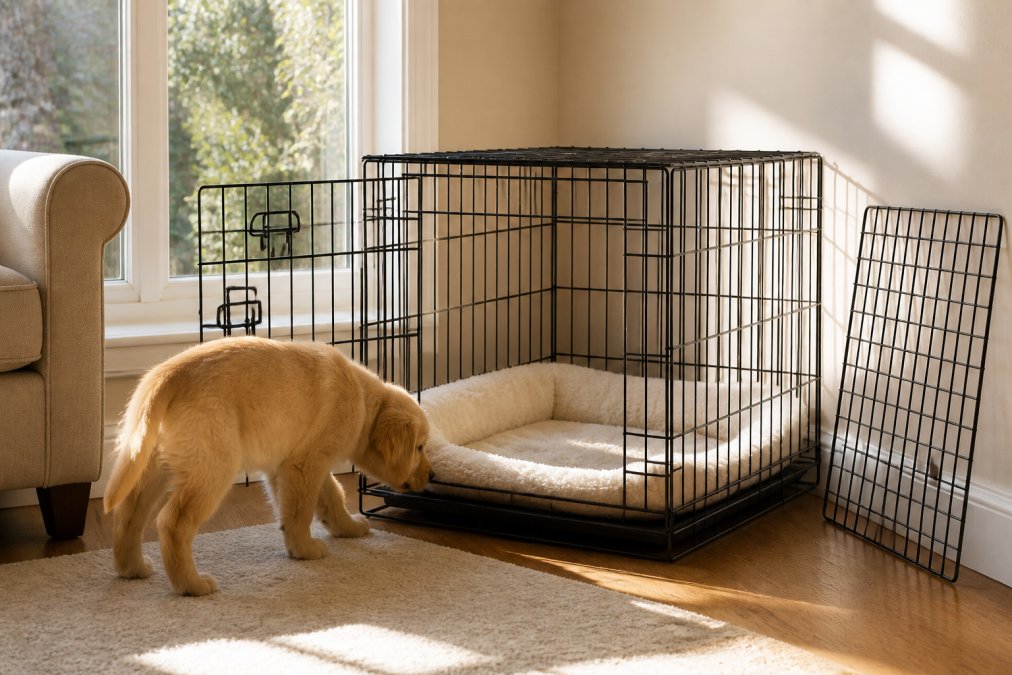
Step 2: Introduce the Crate and Build Positive Reinforcement
Leave the crate door open for the first few days and let curiosity do the work. Toss treats inside, praise any investigation, and never force the puppy in.
Feed treats near the crate, then inside it, then with the door briefly closed. Keep sessions under two minutes; rushing this stage teaches the puppy that the crate predicts being trapped.
Step 3: Feed Meals Inside and Add Crate Games
Meals become your strongest training tool. Put the bowl inside the crate, close the door while the puppy eats, and open it the moment the food is gone, seconds first, then minutes.
Crate games turn confinement into something the puppy chooses. Try these:
- Toss a treat in, mark and reward when the puppy enters
- Close the door for one second, treat, release
- Build to thirty seconds, then one minute
- Add a cue word like "crate" before each repetition
A durable chew toy keeps the puppy busy during longer sessions. The Dog Tug Rope Toy and the ChewPal CuddleBuddy both work for supervised crate time.


How Long Can a Puppy Stay in a Crate?
A puppy can typically hold its bladder for roughly one hour per month of age, plus one, during the day (akc.org). A three-month-old handles about four hours at most; overnight stretches run longer once a routine settles.
Use this as a ceiling, not a target. Young puppies need potty breaks every one to two hours while awake; exceeding the limit teaches the puppy to soil the crate.
| Puppy Age | Daytime Max | Overnight Max |
|---|---|---|
| 8-10 weeks | 1 hour | 3-4 hours |
| 3 months | 3-4 hours | 5-6 hours |
| 4 months | 4 hours | 6-7 hours |
| 6 months | 5-6 hours | 7-8 hours |
How to Stop a Puppy From Crying in the Crate
Most crate crying stems from unmet needs or too much freedom too fast. Before assuming separation anxiety, rule out hunger, a full bladder, or an oversized crate.
Work through this checklist when whining starts:
- Confirm the puppy has eaten and relieved itself
- Check crate size and remove excess space
- Add a worn T-shirt with your scent
- Cover three sides to create a den-like feel
- Ignore brief fussing, respond only to genuine distress
Responding to every whimper teaches the puppy that crying opens the door; waiting for a pause rewards quiet instead.
The Three Types of Crate Crying (and How Each One Sounds)
Not all crying means the same thing. Listen for the pattern:
- Protest crying, loud, rhythmic, starts the second the door closes and fades within 10 to 20 minutes. This is demand behavior. Responding mid-cry reinforces it; waiting for a two-second pause teaches the puppy that quiet opens the door.
- Distress crying, high-pitched, continuous, paired with pacing, drooling, or clawing at the door. A real need is unmet. Check potty, temperature, and crate size before letting the puppy out.
- Frustration barking, sharp, repetitive, often aimed at you across the room. Common in herding and working breeds that want to be near their people. Covering three sides and moving the crate against a wall usually reduces it within days.
When Crying Returns After Weeks of Success
A puppy that slept quietly for three weeks and suddenly screams at 2 a.m. is usually not "testing you", something changed. Check these triggers in order:
- A growth spurt. The puppy may now be too big for the divider setting you chose at 8 weeks. Re-measure: the puppy should stand without ducking and turn around without touching the sides.
- A schedule shift. A daylight saving change, a new work schedule, or a skipped afternoon nap can leave a puppy overtired. Overtired puppies cry like overtired toddlers.
- A developmental fear period. Most puppies pass through a fear period between 8 and 11 weeks and again around 6 to 14 months, when familiar things suddenly seem threatening (avma.org). If the crate is the trigger, slow reintroduction back to 30-second door-closed reps for two or three days.
- A physical issue. Ear infections, teething pain, and urinary tract infections all show up first as nighttime crying. If the crying is new, sudden, and doesn't respond to the above, see a vet.
What Not to Do at 2 A.M.
- Don't open the door mid-scream. Wait for even a two-second pause, then open. This is the single most important rule for breaking a crying cycle.
- Don't move the crate into your bedroom permanently as a fix. It works for a night and then becomes the new baseline.
- Don't add a second blanket, a louder white noise machine, or a bigger crate all at once. Change one variable at a time so you know what worked.
When Crying Is Actually Separation Anxiety
If the puppy drools heavily, paces in circles, bites through the wire, or injures paws and muzzle on the crate door, this is not normal protest and the standard ignore-it advice will make it worse. Stop crate training temporarily, work with a certified behavior consultant, and use a playpen or puppy-proofed room as a bridge while you build a desensitization plan. See the separation anxiety section below.
Puppy Crate Training Mistakes That Slow Progress
The biggest mistake is using the crate as punishment. A crate should read as a safe space, not a timeout zone, or the puppy will resist it for months.
Other common errors:
- Leaving the puppy crated too long and creating accidents
- Skipping the gradual door-closed build-up
- Rushing nighttime training before daytime training is solid
- Removing the crate entirely after one bad night
Consistency matters more than speed: a predictable routine helps the puppy anticipate naps, meals, and potty breaks, reducing whining.
The Mistakes That Actually Derail Training (and Why)
The failures that send owners back to week one are more specific:
- Training the crate only at night. Puppies generalize poorly. If every crate experience happens when the puppy is exhausted, the crate becomes where fun ends. Aim for three positive daytime reps for every nighttime rep during the first two weeks.
- Treating the crate as a babysitter. A crate is a management tool, not a substitute for exercise, potty breaks, or mental work. A puppy crated four hours and then crated again after a five-minute yard break will protest, reasonably.
- Skipping the release cue. If the puppy only leaves when you decide, but you never mark the exit with a word like "free," the door opening seems random. A consistent release cue reduces door-rushing.
- Removing the crate too early. Most puppies need the crate well past six months, and many benefit through the first year. Retiring it the week after a good night commonly causes housebreaking regressions.
- Ignoring the breed. A Border Collie and a Cavalier King Charles Spaniel have very different crate needs. See below.
Apartment-Specific Crate Training
Shared walls change the rules: a crying puppy at 11 p.m. is a training problem, but with a neighbor on the other side it's a housing problem. A few adjustments help:
- Place the crate on an interior wall, not a shared one. Sound travels through shared walls far more than interior partitions. A closet with the door open, a bathroom, or a hallway corner is often the quietest spot in a one-bedroom unit.
- Use a white noise machine on your side of the shared wall, not next to the crate. The goal is to mask the puppy's noise from the neighbor, not to drown out the puppy.
- Talk to your neighbor before the first night. A short heads-up, "we're crate training a puppy for the next two weeks, here's my number if it's ever a problem", prevents most complaints, and managers respond differently to a known, time-limited training period than an unexplained noise issue.
- Check your lease and local rules. Many leases and most municipal noise ordinances have quiet hours, typically 10 p.m. to 7 a.m. If crying regularly breaches those hours, the fix is a faster training pace, not a louder white noise machine.
- Have a backup plan for the first three nights. A playpen in the bedroom, a puppy-proofed bathroom, or a friend's house for the worst night can buy you the time to build crate duration without a noise complaint on day two.
Crate Training High-Energy and Working Breeds
Herding, sporting, and working breeds, Border Collies, Australian Shepherds, Labs, German Shepherds, Huskies, often struggle with the crate for a different reason than companion breeds: rarely fear, usually under-stimulation.
A bored working-breed puppy will chew the crate tray, bark, and pace no matter how many treats you toss in. Front-load mental work before crate time:
- A 10- to 15-minute training session (sit, down, name game, hand targeting) immediately before the crate. Tired brains settle faster than tired bodies.
- A frozen stuffed food toy as the crate-time reward. Freezing a rubber toy with kibble mixed with water or plain yogurt stretches a five-minute snack into a 30-minute project.
- A scent game before crating. Scatter a handful of kibble in a snuffle mat or a folded towel and let the puppy work for it. Nose work is one of the fastest ways to bring a high-drive puppy's arousal level down.
- Shorter, more frequent crate sessions. A working-breed puppy may do better with four 45-minute sessions than two 90-minute ones, at least for the first month.
Companion breeds, Cavaliers, Bichons, Shih Tzus, most toy breeds, need the opposite: more warmth, more proximity, and a slower door-closed build-up. Match the plan to the puppy in front of you, not a generic timeline.
Best Crate Training Treats and Chew Toys
The best crate treats are small, soft, and quick to eat so they don't interrupt training flow. Peanut butter in a rubber toy works for longer sessions; tiny training treats suit rapid repetitions.
Chew toys give the puppy something legal to gnaw during quiet crate time. Rope toys, plush squeakers, and durable rubber chews all work; rotate two or three to keep novelty high.
Crate Training a Puppy With Separation Anxiety
True separation anxiety looks different from normal crate protest: a puppy may drool, pace, or try to escape even after weeks of consistent training.
Slow the pace dramatically. Feed every meal in the crate, keep departures under a minute at first, and build duration in seconds rather than minutes. Pair crate time with a calming chew toy, avoid dramatic goodbyes, and for persistent cases bring in a certified behavior consultant.
Frequently Asked Questions
How long should I let a puppy cry in the crate on the first night?
Expect some whining on night one, but don't wait it out for long stretches. Take your puppy out for a potty break every two to three hours, then return them to the crate with a calm voice and no play. If crying continues past 10 to 15 minutes, check for a bathroom need or discomfort. A worn t-shirt with your scent and a soft bed can help them settle faster.
What is the fastest way to crate train a puppy?
Combine short, frequent sessions with food. Toss treats inside with the door open, feed every meal in the crate, and build up to 10-minute closed-door sessions several times a day. Add crate games like toss-and-treat to make the space rewarding. Most puppies accept the crate within one to two weeks when sessions stay positive and never become a punishment.
What are the most common puppy crate training mistakes?
The biggest mistakes are using the crate for punishment, sizing it too large without a divider panel, and rushing the duration too fast. Others include ignoring potty breaks, responding to crying with attention, and skipping a consistent routine. Puppies also regress during teething or growth spurts, so expect setbacks and return to shorter sessions rather than giving up on the crate.
What are the best crate training treats for a puppy?
Small, soft, high-value treats work best because they're easy to eat quickly inside the crate. Look for pea-sized options like freeze-dried liver, chicken bits, or soft training bites. Pair them with a durable chew toy or a plush squeaky toy to extend calm time. Reserve these special treats for crate sessions only so they stay motivating and don't lose value.
Crate training takes patience, but the payoff is a puppy that settles calmly and a home that stays accident-free. FurEver Finds stocks the beds, chew toys, and enrichment gear that make each step easier, with quality-checked products and next-day delivery on orders placed by 12 PM. Get started with FurEver Finds and give your puppy a crate routine that actually sticks.