


How to Help a Cat With Anxiety at Night
Table of Contents
- Why Your Cat Is Anxious at Night (and How to Tell It Apart From Boredom)
- Signs of Feline Anxiety That Show Up After Dark
- How to Establish a Cat Bedtime Routine That Actually Sticks
- Cat Calming Aids for Nighttime: What to Try and What to Skip
- How to Set Up a Safe Home Base and Enrich the Environment
- Adjusting Play, Feeding, and Sleep Hygiene as Your Cat Ages
- When to Call Your Veterinarian
- Frequently Asked Questions
Last Updated: September 15, 2026
Why Your Cat Is Anxious at Night (and How to Tell It Apart From Boredom)
If you're searching for how to help a cat with anxiety at night, start by separating two things that look identical at 3 a.m.: a cat that's wired to hunt after dark, and a cat that's genuinely distressed. This guide from FurEver Finds walks through both, because the fix is completely different depending on which one you're dealing with.

Cats are crepuscular by nature, most active at dawn and dusk (vcahospitals.com). That's normal. What isn't normal is pacing, yowling, or frantic grooming that repeats every night regardless of what happened during the day. The American Association of Feline Practitioners' behavioral guidelines notes that sudden onset night vocalization in an older cat often signals an underlying medical issue rather than a training problem.
Below, we'll show you exactly how to tell instinct from anxiety, and what to change first.
Nocturnal Instincts vs. Real Feline Anxiety
A bored cat wants a job. An anxious cat wants safety. Bored cats settle once they've burned energy; anxious cats often get worse the more you engage with them at night, because every response reinforces the pattern.
A Medical Screening Checklist Before You Change Anything
Before adjusting routine, rule out pain and disease. Ask your vet to check for:
- Hyperthyroidism (a common cause of nighttime restlessness and vocalization) (Hyperthyroidism in Animals - Endocrine System)
- Hypertension and vision changes
- Dental pain or arthritis
- Cognitive dysfunction in cats over 10
- Urinary or litter box issues
Signs of Feline Anxiety That Show Up After Dark
Signs of feline anxiety at night include pacing, excessive vocalization, over-grooming, hiding, and restlessness that starts within an hour of lights-out. These behaviors cluster around your bedtime because your routine change is the trigger, not the darkness itself.
Watch for these specific patterns:
- Vocalizing directly outside your bedroom door
- Repeatedly checking windows or doorways
- Sudden litter box avoidance
- Destructive scratching on furniture or doors
How to Establish a Cat Bedtime Routine That Actually Sticks
To establish a cat bedtime routine, anchor it to fixed clock times and repeat the same sequence every night for at least two weeks. Consistency matters more than the specific activities.

A Sample Evening Schedule
| Time | Activity | Purpose |
|---|---|---|
| 6:00 PM | Final meal of the day | Prevents 3 a.m. hunger wake-ups |
| 7:00 PM | Interactive play session, 10-15 min | Satisfies predatory sequence |
| 7:20 PM | Small treat or puzzle feeder | Rewards calm behavior |
| 9:30 PM | Dim lights, quiet household | Signals wind-down |
| 10:00 PM | Bedtime, same time nightly | Builds sleep cycle |
Multi-Cat Households: One Routine, Different Needs
Multi-cat households need separate feeding stations and separate play sessions. One anxious cat in a group of three will not settle if it's competing for food or attention at the same time as the others. Feed in different rooms, and give the anxious cat its own play window.
Cat Calming Aids for Nighttime: What to Try and What to Skip
Cat calming aids for nighttime fall into four tiers, and the tier matters more than the brand. Work from the bottom up, and give each option a full two weeks before judging it, most owners quit on day three, right before the effect would show.
Tier 1: Pheromone Therapy
Pheromone diffusers mimic the facial pheromones cats deposit when rubbing their cheeks on furniture, the chemical signal that says "this space is safe." The two common formats are plug-in diffusers (room-wide, continuous) and collars or sprays (cat-specific, portable).
- Diffusers cover roughly one average room. Plug it into the room where your cat actually settles at night, not the hallway. Replace the refill every 30 days; the liquid runs out before the plastic looks empty.
- Sprays work for targeted spots, the carrier, a vet-visit crate, a specific blanket, but need reapplication every few hours, which makes them a poor fit for overnight use.
- Collars are the only format that travels with the cat, useful if your cat moves between rooms at night.
Give pheromones a full two weeks. A common pattern is subtle improvement in week one and a clearer shift in week two.
Tier 2: Environmental Tools
These don't change your cat's chemistry, but they remove the triggers that keep it on alert:
- White noise machines at low volume mask outdoor triggers, other cats, traffic, a neighbor's dog. Place between your cat's sleeping spot and the window, not next to the cat.
- Blackout curtains blunt the dawn light that tells a crepuscular cat the hunt is on at 4:30 a.m.
- Timed feeders remove you from the feeding equation entirely, which matters if your cat has learned that yowling produces a human.
- Night lights in hallways help senior cats navigate without disorientation, which is a common driver of 2 a.m. yowling in cats over 10.
Tier 3: Over-the-Counter Supplements
This is where most owners waste money. The label "calming" is not regulated the way a drug claim is, and many products list a proprietary blend without amounts. If you want to try a supplement, look for one that names the active ingredient and the dose per serving, common ones include L-theanine, alpha-casozepine (a milk protein derivative), and tryptophan. Bring the label to your vet before starting, especially if your cat takes any other medication.
Tier 4: Prescription Options
If routine changes and Tier 1-2 tools haven't moved the needle after four to six weeks, prescription medication is a legitimate next step, not a last resort. Your vet may discuss short-term options for situational anxiety or daily medication for chronic cases. This is a conversation to have with your vet, not a decision to make from a search result.
How to Set Up a Safe Home Base and Enrich the Environment
A safe home base is a quiet, enclosed spot your cat can retreat to without being cornered. Set it up before you change anything else, and let your cat choose whether to use it.
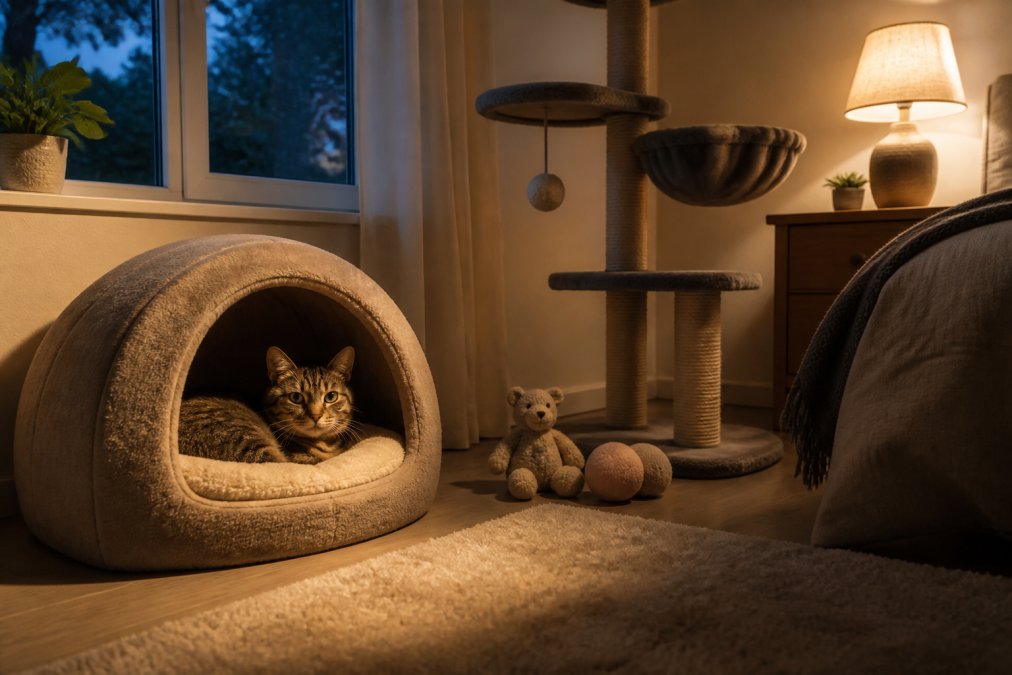
The WarmNest Cozy Cave is built for exactly this: an enclosed, self-warming tent bed that gives a nervous cat a place to hide without feeling trapped.
Vertical Space, Scratching Posts, and White Noise
Adjusting Play, Feeding, and Sleep Hygiene as Your Cat Ages
Kittens (Under 1 Year)
Adults (1-10 Years)
Seniors (10+ Years)
Owner Sleep Hygiene: The Part Most Guides Skip
When to Call Your Veterinarian
Frequently Asked Questions
What are the signs of feline anxiety that show up at night?
Nighttime feline anxiety often looks different from daytime stress. Watch for pacing, repeated vocalization, over-grooming, restlessness, and changes in litter box habits. Some cats also hide more or cling to one room. These signs tend to cluster around the same hours each night, which helps distinguish anxiety from simple boredom. If the behavior starts suddenly in a senior cat, ask your veterinarian about cognitive dysfunction and hyperthyroidism, since both can mimic anxiety after dark.
What can I give my cat to calm down at night?
Start with non-drug options: pheromone diffusers, a predictable bedtime routine, and a quiet home base. These cat calming aids for nighttime work well for mild cases. If your veterinarian recommends something stronger, follow their dosing exactly, since some over-the-counter products are not safe for cats. Never give human sleep aids or antihistamines without veterinary guidance. Prescription options exist for moderate to severe feline anxiety, but they work best alongside behavioral modification, not instead of it.
How can I tell if my cat's nighttime activity is anxiety or just boredom?
Boredom-driven activity usually stops once your cat gets enough daytime play and mental stimulation. Anxiety keeps going even after a full day of enrichment. Look at the pattern: a bored cat zooms, knocks things over, and settles after a play session. An anxious cat paces, vocalizes, over-grooms, and avoids settling even when tired. Try adding 15 minutes of interactive play before bed and see if the behavior drops. If it does not, anxiety is more likely.
When should I consult a veterinarian about my cat's nighttime behavior?
Book a visit if the behavior starts suddenly, gets worse over a few weeks, or comes with weight loss, increased appetite, or litter box changes. Those can point to hyperthyroidism or another medical issue rather than feline anxiety. Also call if your cat injures herself, stops eating, or if you are not sleeping for more than a few nights in a row. A veterinarian can run bloodwork, check for pain, and help you build a plan that combines medical care with behavioral modification.
Night anxiety rarely resolves overnight, and the cats that improve fastest are the ones whose owners change one thing at a time and stick with it. FurEver Finds exists to make that easier, with a curated selection of premium pet essentials, thoughtfully selected for quality, and next-day delivery so you're not waiting a week to start. Get started with FurEver Finds and give your cat the calm, comfortable nights you both deserve.