


How to Introduce a New Pet to an Anxious Cat
Table of Contents
- Why Introducing a New Pet to an Anxious Cat Needs a Different Plan
- Before You Start: Assess Your Cat's Personality and Stress Triggers
- Step 1: Set Up a Sanctuary Room and Scent Swapping
- Step 2: Visual Introductions With Barriers and Baby Gates
- Step 3: Controlled Face-to-Face Meetings on Neutral Territory
- Signs of Cat Stress During Introductions and How to Respond
- How Long to Keep Pets Separated: A Realistic Timeline
- Best Calming Aids for Anxious Cats: What Actually Works
- Frequently Asked Questions
Last Updated: September 5, 2026
Bringing a new pet home is joyful for you, but for a resident feline, it can feel like a territorial invasion. For an anxious cat, a new dog or kitten can trigger a full flight-or-fight response leading to hiding, appetite loss, and behavioral regression. This guide from FurEver Finds walks you through a slow, structured introduction plan that prioritizes your cat's emotional safety.
The biggest mistake owners make is rushing. For a nervous cat, a forced meeting confirms the house is no longer safe. The goal is teaching your anxious cat that the new arrival predicts good things, not danger, using desensitization and counter-conditioning.
Why Introducing a New Pet to an Anxious Cat Needs a Different Plan
A confident cat may accept a new housemate within days, but an anxious cat operates on a different neurological baseline. Their stress response triggers more easily, and once cortisol spikes, learning stops. Standard advice to "let them sniff through the door" often isn't enough.
Manage the environment so the cat never feels cornered: control sight lines, provide escape routes, and ensure the new pet cannot chase. A trapped anxious cat may bite or stop using the litter box entirely.
The plan below uses incremental exposure, advancing only when your cat shows consistent calm behavior. Skipping ahead risks chronic anxiety that is difficult to reverse.
Before You Start: Assess Your Cat's Personality and Stress Triggers
Before the new pet enters the house, audit your resident cat's baseline. A cat who hides from visitors will need a significantly longer introduction timeline than one who greets guests at the door.
Watch for stress signals: flattened ears, tail lashing, dilated pupils, and excessive grooming. If these are regular, she may benefit from environmental enrichment like cat trees, which allow her to observe from a safe height.

Step 1: Set Up a Sanctuary Room and Scent Swapping
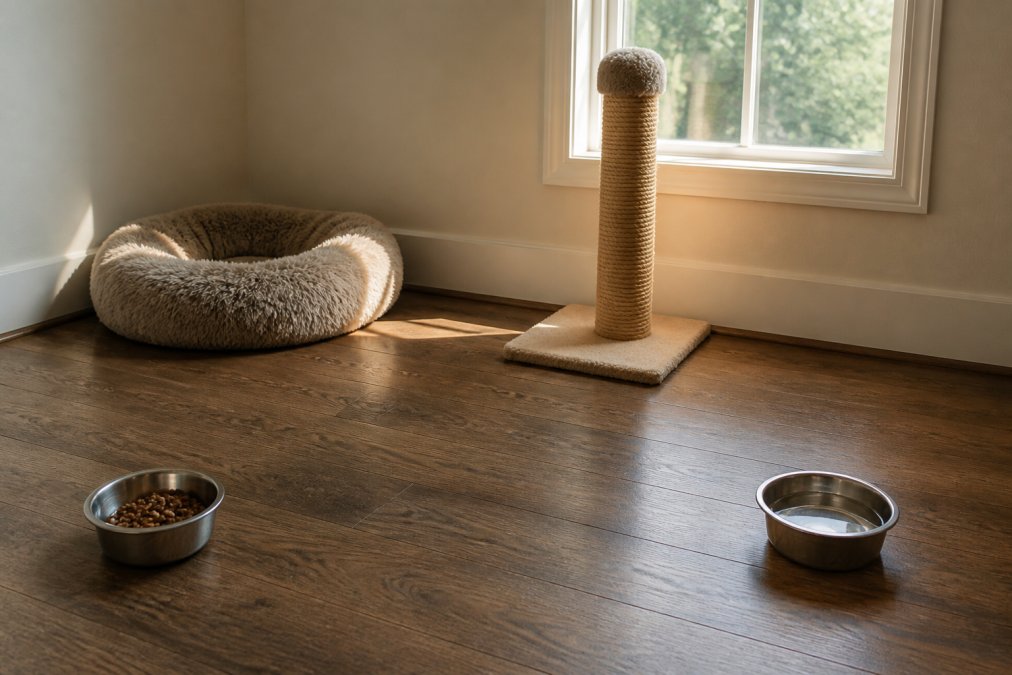
The sanctuary room is the cornerstone of this process, a dedicated space where the resident cat can retreat without fear of the new pet following. It should contain food, water, a litter box, and a comfortable hiding spot.
Set up the sanctuary room before the new pet arrives. Once the new pet is home in a separate area, begin scent swapping: rub a clean cloth on the new pet's cheeks and place it near your cat's food bowl, and do the reverse with a cloth from your cat. This associates the other's scent with positive experiences like eating.
Step 2: Visual Introductions With Barriers and Baby Gates
Once your cat eats calmly near the new pet's scent, progress to visual contact, but they must never touch. Use a sturdy baby gate stacked with a second barrier, or a door opened just a crack, to create a safe visual buffer.
During these sessions, feed both animals a high-value treat on either side of the barrier, counter-conditioning in action. If your anxious cat hisses or growls, you have moved too fast; close the door and revert to scent swapping for another day or two.
Keep sessions short, five to ten minutes, several times a day. If the new pet barks or lunges at the gate, add a second barrier or move them further away until calm.
Step 3: Controlled Face-to-Face Meetings on Neutral Territory
Visual introductions succeed when the cat shows relaxed body language without fixating on the other pet. Now attempt a controlled meeting in neutral territory, like a large living room, rather than the sanctuary room.
Keep the new pet on a leash or in a secure carrier. Let the cat approach at her own pace; never force physical contact. Intervene if either animal stiffens or stares intently without blinking, a precursor to aggression.
If the meeting goes well, reward both animals heavily with treats and praise. If not, separate them calmly and return to the barrier phase. Regression is normal; you may need to repeat earlier steps several times.
Signs of Cat Stress During Introductions and How to Respond
Reading your cat's stress level is about recognizing the escalation ladder. An anxious cat rarely goes from calm to aggressive without intermediate warning signs. Knowing which rung she is on tells you whether to pause, step back one phase, or stop entirely.
The Stress Escalation Ladder
Level 1: Mild Discomfort (Continue but slow down)
- Licking lips when no food is present
- Ears rotating backward like airplane wings
- Tail swishing with a wide, sweeping motion
- Half-blinks or avoiding direct eye contact
- Freezing in place for more than 5 seconds
Level 2: Moderate Distress (End the session, step back one phase)
- Flattened ears pressed sideways against the head
- Dilated pupils with a fixed stare at the new pet
- Low growl or a soft, throaty yowl
- Crouched posture with weight shifted backward
- Sudden, excessive grooming of the flank or belly
Level 3: Severe Overwhelm (Stop all introductions for 48-72 hours)
- Hissing with an open mouth and visible teeth
- Piloerection (hackles raised along the spine)
- Spraying urine on vertical surfaces
- Eliminating outside the litter box
- Aggression redirected toward you or other household members
The 15-Minute Rule
If your cat shows Level 1 signs, continue but shorten the session to 5 minutes and end with a treat. For Level 2 signs, calmly separate the animals and close the door; do not attempt another session for 4-6 hours. For Level 3 signs, the timeline was too aggressive, return to full separation and restart from scent swapping.
Post-Introduction Regression: The Problem No One Warns You About
A confusing scenario: the cat and new pet coexist peacefully for a week or two, then suddenly the cat starts hissing, swatting, or hiding again. This is not a failure, it is a common pattern called post-introduction regression.
Regression typically occurs for one of three reasons:
- Resource competition becomes real. During the introduction, you were supervising and providing separate bowls. Once you relax, the new pet may approach the cat's food bowl or favorite sleeping spot, triggering a territorial response.
- The cat's confidence was borrowed, not owned. She was calm because you were present and the environment was controlled. When left alone, her underlying anxiety resurfaces.
- A single scary incident. The new pet barked suddenly, chased her, or cornered her in a room with no exit. One bad experience can erase weeks of positive conditioning.
How to Respond to Regression
Do not punish the cat or scold the new pet. Treat regression as data, your cat is telling you a specific threshold was crossed.
- Step back one full phase. If you were in supervised freedom, return to leashed meetings. If you were in leashed meetings, return to visual barriers. Rebuild the positive association at the level where she was last consistently calm.
- Audit the environment. Are there enough resources? The rule of thumb is one more litter box than the number of cats, and food/water stations in at least two separate locations. A single shared resource is the most common regression trigger.
- Reintroduce the sanctuary room. Even if the cat has been using the whole house, close the door to the sanctuary room for 2-3 days to give her a guaranteed safe zone.
- Increase vertical space. If regression happens repeatedly, the cat may not have enough high perches to feel secure. Adding a wall shelf or cat tree in the main living area gives her an escape route that the new pet cannot follow.
When to Pause vs. When to Stop
A temporary pause of 3-5 days is normal and expected. Stopping the introduction entirely is only warranted if the cat shows Level 3 signs consistently for more than two weeks despite full separation, or if she stops eating for more than 24 hours. In those cases, consult your veterinarian about anti-anxiety medication before attempting a reintroduction.
The most important skill you can develop is distinguishing between a cat who is annoyed (ears back, tail flicking) and a cat who is terrified (crouched, dilated pupils, hissing). Annoyance will resolve with time and space. Terror requires you to intervene immediately and rebuild trust from scratch.
How Long to Keep Pets Separated: A Realistic Timeline
There is no universal answer, but a realistic timeline for an anxious cat is four to six weeks before sharing space unsupervised. Some confident cats integrate in two weeks; deeply anxious cats may require three months or more.
| Phase | Duration | Key Milestone |
|---|---|---|
| Sanctuary & Scent Swapping | 3-7 days | Cat eats calmly near new pet's scent |
| Visual Barriers | 1-2 weeks | Cat shows relaxed body language at the gate |
| Leashed Meetings | 1-2 weeks | Cat remains calm for 10+ minutes |
| Supervised Freedom | 2-4 weeks | Cat chooses to stay in the same room voluntarily |
During the final phase, supervise all interactions. Do not leave the animals alone together until you have seen consistent calm behavior for at least a week. If regression occurs, step back one phase and rebuild positive associations.

Best Calming Aids for Anxious Cats: What Actually Works
Behavioral modification is the foundation, but for an anxious cat, the stress response can make learning impossible. Calming aids are not a replacement for the introduction plan, they are the support structure that makes it executable.
Pheromone Therapy: The First-Line Tool
Synthetic feline facial pheromones (analogs of the F3 fraction) signal that an area is safe (peer-reviewed research). The two main options are diffusers (like Feliway) and collars. Diffusers cover roughly 700 square feet and need to be plugged in 24/7 for at least two weeks before the introduction (veterinarypartner.vin.com). Collars are useful for multi-room homes or spaces without an outlet.
A common mistake is placing a single diffuser in the sanctuary room. For an anxious cat, place one there and another in the main living area where visual introductions occur. Replace the refill every 30 days, a depleted diffuser is a silent failure point.
Nutraceuticals and Calming Supplements: Know the Active Ingredients
Over-the-counter calming supplements vary wildly in quality. Look for products with one of these evidence-backed ingredients:
- L-theanine (an amino acid found in green tea), promotes relaxation without drowsiness; often dosed at 25-50 mg per cat.
- Alpha-casozepine (a milk protein derivative), marketed under names like Zylkene; has shown anxiolytic effects in cats in some veterinary studies.
- Tryptophan, a precursor to serotonin, though its efficacy in cats is less consistent than in dogs.
Avoid products that rely solely on herbal blends like valerian or chamomile, as these have minimal peer-reviewed support in felines. Gels and chews are easier to dose than powders mixed into food, which an anxious cat may refuse to eat.
Prescription Medication: When to Escalate
If your cat is hiding for more than 48 hours, refusing food, or exhibiting self-destructive grooming, behavioral aids are not enough. This is the point where you must involve your veterinarian. Do not wait for the introduction to fail catastrophically.
Veterinarians typically prescribe one of two classes of medication for situational anxiety:
- Benzodiazepines (e.g., alprazolam), fast-acting, used for acute panic events like a sudden hissing fit. These are not for daily use due to tolerance and potential paradoxical agitation.
- SSRIs or TCAs (e.g., fluoxetine or clomipramine), daily maintenance medications that raise the cat's threshold for triggering the stress response. They take 3-6 weeks to reach full effect, so they must be started well before the introduction phase you expect to be hardest.
A common pattern practitioners see is owners requesting medication only after a failed introduction has already cemented a negative association. The more effective approach is a proactive veterinary consult during the sanctuary room phase, especially for a cat with a known history of anxiety or prior trauma.
Physical Comfort as a Calming Aid
The WarmNest Cozy Cave self-warming tent bed serves a dual purpose: it is a hiding spot and a thermal comfort device. Cats experiencing stress lose body heat through their ears and paws, and a self-warming bed that reflects radiant heat helps regulate their core temperature, which in turn reduces the metabolic cost of anxiety. Place this bed inside the sanctuary room, positioned so the cat can see the door but is not directly in the sightline of the new pet. This gives her a 'safe den' where she can retreat and decompress between introduction sessions.

The Hierarchy of Aids
- Environmental management (vertical space, hiding spots), always first.
- Pheromone diffusers, baseline safety signal for the whole home.
- Nutraceuticals, for mild to moderate anxiety, started a week before introductions.
- Prescription medication, for severe anxiety or when steps 1-3 fail after 2 weeks.
Calming aids are not a shortcut; they are the scaffolding that allows the slow introduction process to actually work. If your cat is too stressed to eat a treat near the baby gate, no amount of counter-conditioning will help until her baseline anxiety is lowered.
Frequently Asked Questions
How long should the separation period last for a nervous cat?
For an anxious cat, plan on a minimum of 3 to 7 days of complete separation. During this time, the new pet stays in a sanctuary room and you swap scents daily. Watch for signs of cat stress during introductions, like hiding or reduced appetite. If your anxious cat seems settled, you can move to visual introductions. Some cats need 2 to 3 weeks before they tolerate face-to-face meetings. Rushing this stage often causes setbacks, so let your cat set the pace.
What are the best calming aids for anxious cats during introductions?
Pheromone diffusers, such as Feliway, are a first-line choice because they mimic natural feline facial pheromones. Calming treats with L-theanine or tryptophan can also help take the edge off. The WarmNest Cozy Cave gives your anxious cat a secure hideaway where they can retreat and regulate their body heat. Pair any aid with positive reinforcement: offer high-value treats during brief, calm interactions. Avoid sedatives unless a veterinarian prescribes them.
Will getting another cat help my anxious cat or make it worse?
It depends on why your cat is anxious. If the anxiety stems from boredom or being alone while you work, a confident, friendly companion can help. If your cat is territorial or easily overwhelmed by change, adding a new pet usually increases stress. Watch for stress signals like hissing, growling, swatting, hiding, and appetite loss during the introduction process. An anxious cat often needs environmental enrichment and routine stability before they are ready to accept a housemate.
What should I do if my anxious cat hisses and swats at the new pet?
Immediately separate them and return to the previous introduction stage. Hissing and swatting are clear signs of cat stress during introductions, not aggression that will fade on its own. Re-establish the sanctuary room setup and spend 2 to 3 more days on scent swapping alone. Use positive reinforcement to build a calm association: give your cat treats and praise when they remain relaxed near the door. If intense hissing continues, consult a veterinary behaviorist.
This article was written using GrandRanker