


Signs Your Senior Dog Needs a New Bed
Table of Contents
- Signs Your Senior Dog Needs a New Bed
- How to Distinguish a Bed Problem from a Medical Problem
- Mobility Changes: When to Replace a Dog Bed
- Best Bed for Senior Dogs: What to Look For
- How to Choose a Dog Bed for an Older Dog
- Senior Dog Sleeping More Than Usual: When It Signals Bed Issues
- A Practical At-Home Bed Assessment
- Transitioning Your Senior Dog to a Replacement Bed
- Frequently Asked Questions
Last Updated: October 6, 2026
Signs Your Senior Dog Needs a New Bed
Your senior dog's bed is where they spend hours resting and recovering. But many pet parents don't realize when that bed has stopped doing its job.
A worn-out dog bed can worsen joint pain, disrupt sleep, and cause behavioral changes that look like age-related decline. Recognizing the signs your senior dog needs a new bed is straightforward, and replacing it can dramatically improve their comfort and mobility.
Below are the signs to watch for, how to distinguish bed issues from medical ones, and what to look for in a replacement.
The bed is visibly worn, flat, or misshapen
Start with the obvious: does the bed still hold its shape, or has it flattened? A bed that's lost its cushioning is just a thin layer between your dog and the floor.
Check for these visual red flags:
- Permanent indentations that don't spring back after your dog gets up
- Visible sagging in the center or edges
- Lumpy, uneven surface where foam has shifted or compressed unevenly
- Discoloration or staining that won't come clean, even after washing
Press your hand into the bed. Quality foam should rebound quickly; if your hand sinks in and stays, the cushioning is gone. This is especially problematic for senior dogs, whose joints need that support more than ever.
Loss of support and spring-back
When foam loses its elasticity, it stops supporting your dog's weight. Senior dogs on a flat, non-resilient surface face increased pressure on their hips, shoulders, and spine, the exact areas where arthritis develops.
Press down firmly for five seconds, then release. If the indentation lingers, the foam has deteriorated and no longer conforms to your dog's body.
This loss of support is invisible from a distance, but your dog feels it every night. Senior dogs need beds that cradle their weight and distribute pressure evenly.
Rips, damage, or persistent odors
Visible rips, tears, or holes let stuffing escape and dust accumulate. Worse, persistent odors that won't wash out signal that moisture, bacteria, or urine has penetrated the foam core.
Senior dogs sometimes have accidents due to incontinence or mobility issues. If urine has soaked into the foam, washing the cover won't help; the smell lingers and the unhygienic interior can irritate your dog's skin.
If you notice any of these, replacement isn't optional, it's a health decision.
How to Distinguish a Bed Problem from a Medical Problem
Your senior dog's behavior changes can stem from a bad bed or an underlying medical issue. The difference determines whether you need a new bed, a vet visit, or both.
Bed-related signs are situational and improve when your dog rests elsewhere.
Medical issues persist regardless of where your dog rests. Arthritis, hip dysplasia, or spinal pain doesn't disappear with a new location, and incontinence, difficulty breathing, or lethargy continues day and night.
If your dog's mobility improves noticeably with a new bed within 2-3 weeks, the old bed was the culprit. If problems persist, schedule a veterinary checkup. Many senior dogs benefit from both a supportive new bed and medical management.
Mobility Changes: When to Replace a Dog Bed
Mobility problems in senior dogs often look like age, but a bad bed amplifies them.
Difficulty lying down or getting up
Senior dogs with joint issues already struggle with transitions, and an unsupportive bed makes it worse. If your dog hesitates before lying down, circles repeatedly, or takes longer to stand up after resting, their bed may be part of the problem.
A bed that's too low or soft forces your dog to work harder to lie down and stand up, while one that's too firm or flattened creates painful pressure points.
If your dog struggles more on their old bed than on other surfaces, a replacement designed for senior dogs can help significantly.
Restlessness and frequent repositioning
A comfortable dog settles into one spot. A dog on an uncomfortable bed tosses, turns, and changes positions all night, a sign they can't get comfortable.
Senior dogs need beds that conform to their shape and reduce pressure points. Without that, they wake frequently and never reach deep, restorative sleep, which compounds mobility and behavioral issues.
Avoiding the bed or sleeping on the floor
This is one of the clearest signs: your dog used to love their bed but now chooses the hard floor. They're voting with their body.
Some senior dogs prefer cool, hard surfaces because their joints hurt less on firm ground, but many are simply avoiding a painful or unsupportive bed. If your dog chooses tile or hardwood over their padded bed, try a replacement before assuming it's a temperature preference.
Best Bed for Senior Dogs: What to Look For
Not all dog beds are equal, especially for senior dogs. The right bed combines support, accessibility, and comfort to match your dog's needs.
Memory foam or orthopedic support is essential. These materials conform to your dog's body and distribute pressure evenly, reducing stress on arthritic joints. Choose high-density foam that won't compress flat.
Raised or elevated designs keep your dog off cold floors and improve airflow, which helps regulate temperature.

Easy-to-clean surfaces matter for senior dogs prone to accidents. Choose machine-washable covers or removable liners, plus no-slip bottoms so your dog doesn't slide when getting up.
Enclosed or semi-enclosed designs provide security and warmth.
How to Choose a Dog Bed for an Older Dog
Selecting the right bed means matching three key factors to your dog's needs.
Matching size and weight capacity
A bed that's too small cramps your dog and aggravates joint pain; one that's too large feels unstable. Measure your dog stretched out in their natural sleeping position and add a few inches on all sides.
Weight capacity matters too: a bed rated for 50 pounds supporting a 60-pound dog compresses faster. Check the manufacturer's specs, not just the size category.
For small senior dogs, the Small Quiettime Deluxe Coco Chic Pet Bed from FurEver Finds is sized at 22 x 17 inches and suits dogs between 12-20 pounds. At $23.80, it's an affordable option for small breeds. The ultra-soft synthetic fur and machine-washable design make it practical for daily use.
Orthopedic support and joint relief
Senior dogs with arthritis need beds that actively support joints, not just cushion. Orthopedic beds reduce pressure on hips, shoulders, and spine.
Memory foam is the gold standard because it conforms to your dog's shape and distributes weight evenly. High-density foam holds its shape longer, so the bed won't flatten after a few months.
If your dog has severe joint pain, consider a bed paired with access aids. The Dog Stairs Ramp for Bed from FurEver Finds helps senior dogs climb onto higher beds without jumping, reducing impact on joints. Made with high-density foam and a removable, machine-washable cover, it supports pets up to 50 pounds. At $377.99, it's a comprehensive solution for dogs struggling with bed access.

Ease of access and entry height
A bed that's too high is useless for a senior dog that can't climb onto it, while one that's too low forces joints to bend more sharply, which can be painful.
The ideal height lets your dog step up without jumping or straining. Low-profile beds suit severe mobility issues; ramps or stairs help dogs that can still climb but need assistance.
The Foldable 2-In-1 Dog Stairs from FurEver Finds are precisely engineered at 17.13 inches to match standard sofa and bed heights. The gradual, ramp-like incline is specifically designed for aging and arthritic dogs. The four wide steps reduce joint stress, and the non-slip fabric provides stable footing. At $99.13, it's an affordable way to make furniture accessible. When not in use, it folds into a compact footstool.
Senior Dog Sleeping More Than Usual: When It Signals Bed Issues
Senior dogs naturally sleep 12-16 hours a day, but there's a difference between restful sleep and sleeping to avoid activity due to discomfort.
If your dog sleeps excessively AND shows other signs, reluctance to move, stiffness after rest, or avoiding their bed, the bed may be contributing. A supportive bed that improves sleep quality often leads to more active waking hours.
Pay attention to sleep quality, not just quantity. Frequent waking and repositioning are signs the bed isn't comfortable enough for deep sleep.
A Practical At-Home Bed Assessment
Before buying a replacement, assess your current bed's condition. This takes five minutes and gives you concrete data.
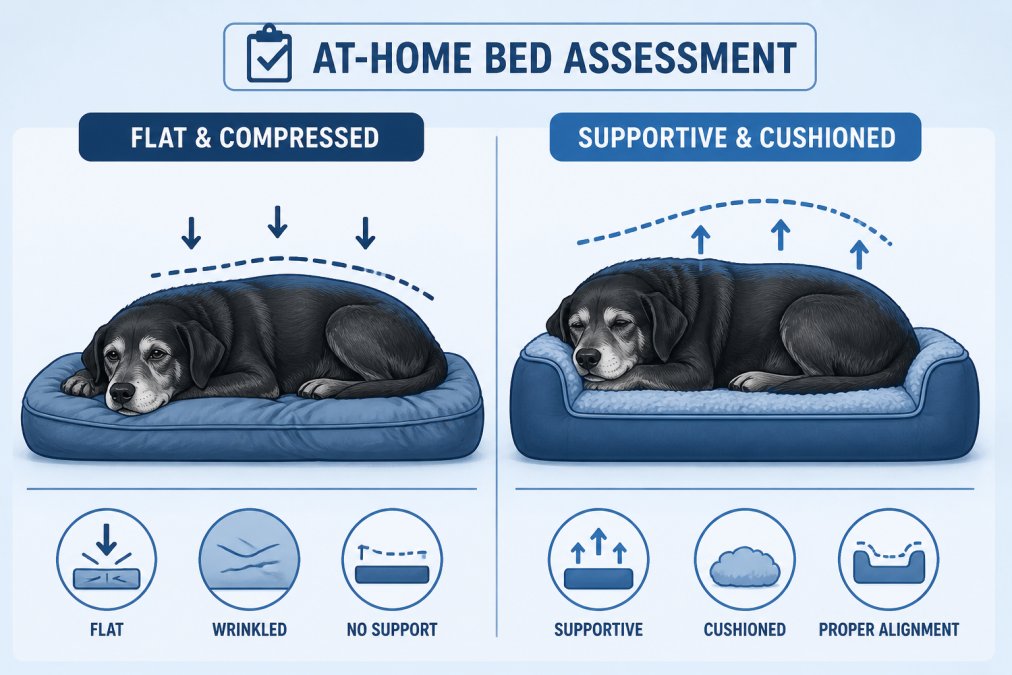
Step 1: Visual inspection. Look at the bed from above and the side. Is it flat, lumpy, or discolored?
Step 2: The press test. Press your hand firmly into the center for five seconds, then release.
Step 3: The smell test. Does the bed smell fresh after washing, or do odors linger?
Step 4: The location test. Does your dog prefer this bed to other spots, or choose the couch or floor instead?
Step 5: The recovery observation. After your dog gets up, does the bed spring back within a minute, or stay compressed?
If your bed fails more than two tests, replacement is worth considering.
Transitioning Your Senior Dog to a Replacement Bed
Introducing a new bed doesn't always go smoothly. Senior dogs are creatures of habit, so here's how to ease the transition.
Start with familiarity. Place the new bed in the same location as the old one; keeping that spot consistent helps your dog adjust faster.
Add comfort cues. Rub your hands on the new bed or spray it with a calming product.
Give it time. Some dogs explore the new bed within hours; others take a few days. Patience matters.
Observe and adjust. Watch how your dog interacts with the new bed.
Combine with other supports if needed. If your dog struggles with bed access, add stairs or a ramp.
Most senior dogs adjust to a quality replacement bed within 1-2 weeks, with noticeable improvements in mobility, sleep quality, and comfort.
At FurEver Finds, your senior dog's comfort is non-negotiable. We've curated supportive, durable beds designed for older dogs, from orthopedic memory foam to elevated designs that keep joints off hard floors.
| Assessment Test | What to Look For | Indicates Replacement Needed |
|---|---|---|
| Visual inspection | Flat, lumpy, or discolored appearance | Yes if bed is visibly worn |
| Press test | Indentation disappears in under 5 seconds | Yes if recovery is slow |
| Smell test | Fresh scent after washing | Yes if odors persist |
| Location preference | Dog chooses bed over other surfaces | Yes if dog avoids the bed |
| Recovery observation | Bed springs back to shape within 1 minute | Yes if compression is permanent |
Frequently Asked Questions
What type of bed is best for a senior dog?
Orthopedic or memory foam beds provide the best support for senior dogs, especially those with joint pain or arthritis. Look for beds with adequate cushioning, firm edges for easier entry and exit, and washable covers for hygiene. The Elevated Dog Cooling Bed ($171.95) offers airflow and durable support, while the Dog Stairs Ramp for Bed ($377.99) helps reduce jumping strain. Choose a size that lets your dog stretch fully without hanging off edges.
How often should you replace a dog bed?
Most dog beds last 2-3 years with regular use, but senior dogs may need replacements sooner if the bed shows visible wear, flattening, or loss of support. Check your dog's bed every 6-12 months for signs of deterioration. If your senior dog avoids the bed, struggles to get comfortable, or shows increased stiffness after rest, it's time to replace it. Worn beds lose their ability to cushion joints and provide pressure relief.
Can an orthopedic bed help an older dog with joint discomfort?
Yes. Orthopedic beds reduce pressure on joints and provide targeted support for arthritic or stiff dogs. They help distribute weight evenly, decrease pain during rest, and improve sleep quality. Paired with dog stairs like the Foldable 2-In-1 Dog Stairs ($99.13) or Dog Stairs Ramp for Bed, orthopedic bedding creates a complete comfort solution that reduces strain on hips, shoulders, and knees throughout the day.
How can I tell if my senior dog is uncomfortable in their bed?
Signs include restlessness, frequent repositioning, difficulty lying down or rising, reluctance to use the bed, and sleeping on the floor instead. Your dog may also show stiffness or pain after resting, take longer to stand after sleep, or prefer hard surfaces. If your senior dog was comfortable in their old bed but now avoids it, the bed has likely lost its support and needs replacement.