


How Long Do Calming Collars Work for Dogs?
Table of Contents
- How Long Do Calming Collars Work for Dogs?
- The 30-Day Standard and What Drives It
- Pheromone vs. Herbal Collar Lifespans
- How Long Do Pheromone Collars Last?
- How to Use Calming Collars Effectively
- Calming Collar Side Effects and Safety
- Replacement Schedules Based on Your Dog's Activity Level
- Troubleshooting When Calming Collars Stop Working
- Frequently Asked Questions
Last Updated: September 13, 2026
How Long Do Calming Collars Work for Dogs?
Most calming collars for dogs release their active ingredients for about 30 days, though that shifts with the formula, your dog's activity level, and how well the collar fits (avma.org). This guide from FurEver Finds breaks down what drives that timeline, how to tell when a collar has stopped working, and how to get the most out of every one you buy.
If you have watched your dog pace during a thunderstorm or shred the blinds when you leave, you know how exhausting anxiety can be. Calming collars are one of the simplest tools available, but the "how long do calming collars work for dogs" question trips up more owners than almost any other. The short answer is roughly a month; the longer answer is where things get interesting.
The 30-Day Standard and What Drives It
The 30-day figure is not arbitrary. Pheromone-based collars rely on a sustained release mechanism, and the active ingredients deplete predictably when the collar stays in contact with your dog's skin. Body heat activates the release, so a loose collar or one left on a shelf will not behave the same way.
Three factors shorten or extend that window:
- Coat length and thickness: A collar buried under a dense double coat diffuses less effectively and may seem to fade sooner.
- Activity level: Dogs that swim, roll in mud, or get frequent baths lose active ingredients faster.
- Fit and skin contact: A collar that slides around does not maintain the consistent contact the release mechanism depends on.
Herbal collars, which typically rely on essential oils rather than synthetic pheromones, tend to fade faster because the oils evaporate. Many owners report noticeable decline within two to three weeks.
Pheromone vs. Herbal Collar Lifespans
Pheromone collars generally hold their effect for the full 30 days, while herbal collars often lose potency in two to three weeks, depending on how each delivers its active ingredients.
Pheromone-based collars use synthetic pheromones that mimic the calming signals a mother dog produces for her puppies. These compounds release slowly and steadily through body heat activation, so the manufacturer's stated duration tends to hold up.
Herbal collars depend on plant extracts, often lavender, chamomile, or valerian root. These oils are volatile, evaporating into the air rather than binding to the skin, which makes them pleasant to smell but shorter-lived. If you choose an herbal option, plan to replace it more often and expect diminishing returns in the final week.
How Long Do Pheromone Collars Last?
Pheromone collars last approximately 30 days under normal conditions, which is why nearly every manufacturer prints that number on the package. The continuous release design is calibrated to that window, and the active ingredients are largely spent by day 30.
What Actually Happens Inside the Collar
The active ingredient in most pheromone collars is a synthetic analog of the dog appeasing pheromone (DAP) that a lactating mother dog secretes to calm her puppies (PubMed). It is suspended in a polymer matrix inside the collar strip; body heat softens that matrix, and the pheromone migrates to the surface and evaporates around your dog's face and neck. That is why the collar must sit against skin, not on top of fur: heat transfer drives the release.
The release rate is not linear. Most collars emit strongest during the first week, hold a plateau through roughly day 21, then taper through the final week. That taper is why owners describe the collar as "fading" rather than "stopping." By day 30 the emission rate is low enough that most dogs no longer show a measurable response, even though a faint scent may linger.
Variables That Move the 30-Day Number
| Factor | Effect on Duration | What to Do |
|---|---|---|
| Frequent swimming or bathing | Shortens by several days | Remove before water exposure |
| Long, dense coat | Reduces diffusion efficiency | Part the fur so the collar sits against skin |
| Loose fit | Wastes active ingredients | Tighten to two-finger snugness |
| Indoor-only, low activity | Often reaches full 30 days | Replace on schedule anyway |
| High humidity | Slightly accelerates evaporation | Store spares in a sealed bag |
How to Tell a Collar Is Spent
Pheromone collars do not "run out" dramatically; the effect tapers. You will rarely notice the exact day it stops working, which is why calendar reminders matter more than your nose.
A few practical signals that the collar has passed its useful window:
- Your dog's baseline behavior (pacing, whining, shadowing you) returns to pre-collar levels.
- Storm or separation triggers that were blunted in week one now produce the full response again.
- The collar strip feels stiffer or drier than it did when new.
None of these is a perfect test. The most reliable method is to log the start date and replace on a fixed interval rather than waiting to observe a change.
How to Use Calming Collars Effectively
Getting the full 30 days out of a calming collar comes down to correct fit and smart pairing with other anxiety tools. Most owners get the first one wrong.
Proper Fit and Skin Contact
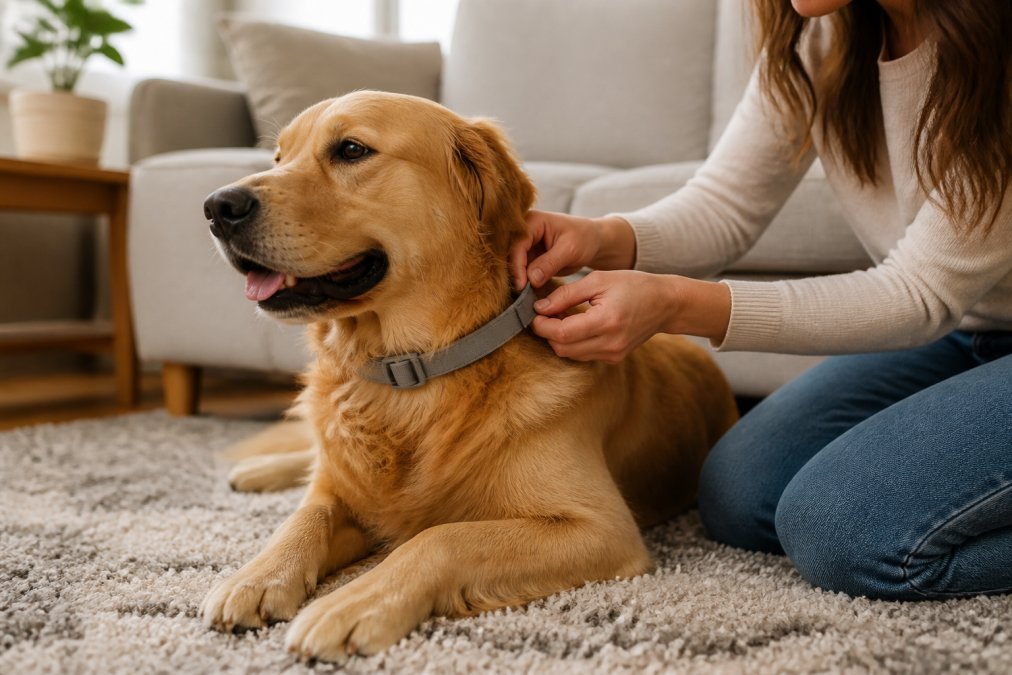
The collar needs direct, consistent contact with your dog's skin. A common mistake is leaving it loose like a standard collar, which lets it slide down the neck and break the contact the release mechanism depends on.
Here is the fit check:
- Slide two fingers under the collar. If you can fit more, tighten it.
- Confirm the collar sits high on the neck, near the base of the skull.
- Part long fur so the collar touches skin rather than resting on top of the coat.
- Check daily for the first week, since collars can stretch slightly.
If your dog has sensitive skin, watch for redness or irritation at the contact point during those first few days.
Pairing With Other Anxiety Treatments
Calming collars work best as one layer of a broader plan, not a standalone fix. Many owners pair a collar with behavioral modification, a predictable routine, and environmental changes such as a covered crate or white noise during storms.
For dogs with severe separation anxiety or thunderstorm phobia, a collar alone is unlikely to be enough. A veterinary consultation can help you build a fuller plan, which may include pheromone diffusers, calming chews, or prescription support. The collar handles the background hum of stress. It does not replace training or medical care.
Calming Collar Side Effects and Safety
Most dogs tolerate calming collars without issue, but side effects do occur. The most common complaints are mild skin irritation at the contact point, redness, and occasional hair loss under the collar (vcahospitals.com). These usually clear up once the collar is removed or repositioned.
Safety precautions worth following:
- Choose a breakaway design if your dog is ever unsupervised or outdoors. A standard buckle collar can snag on fencing or branches, and a breakaway releases under pressure.
- Remove the collar before baths and swimming to preserve the active ingredients and prevent skin reactions to wet material.
- Watch for allergic reactions in the first 48 hours, particularly with herbal collars that contain essential oils.
- Keep collars away from puppies under 12 weeks unless your veterinarian approves, since very young dogs have more sensitive skin.
If your dog shows signs of distress, excessive scratching at the neck, or behavioral changes after a new collar goes on, take it off and talk to your vet before trying another.
Replacement Schedules Based on Your Dog's Activity Level
A fixed 30-day rule works for most dogs, but active dogs need a faster schedule. Think of it as a sliding scale rather than a single number. Activity matters not because your dog "uses up" the pheromone by moving, but because water, friction, and heat accelerate how fast the polymer matrix releases its payload.
Why Activity Shortens the Lifespan
Three mechanisms drive the difference:
- Water exposure. Swimming, baths, and rain dissolve and carry away surface pheromone before it can evaporate into the air where your dog breathes it. A single swim can strip several days of remaining life.
- Friction. A collar that rubs against a harness, a fence, or rough terrain abrades the polymer surface, exposing fresh matrix and speeding release.
- Heat. A dog that runs hot (post-exercise, in summer, or with a thick coat) drives the release rate higher than a dog resting in air conditioning.
None of these is dangerous. They simply mean the 30-day figure is a ceiling, not a guarantee.
A Practical Replacement Scale
| Dog Profile | Replace Every | Why |
|---|---|---|
| Low activity, indoor-only | 30 days | Baseline release rate |
| Moderate activity, daily walks | 28 days | Minor friction and heat exposure |
| High activity, swimming, or frequent bathing | 21 to 25 days | Water strips surface pheromone |
| Very long or dense coat | 25 to 28 days | Less efficient diffusion to skin |
| Senior or sedentary dog | 30 days | Minimal environmental loss |
How to Find Your Dog's Actual Interval
The table is a starting point, not a prescription. To dial in the right cycle:
- Log the start date on the package with a permanent marker.
- Note the first day you observe the calming effect fading (return of pacing, whining, or trigger reactivity).
- Subtract two days from that number and use it as your replacement interval going forward.
If you replace on day 28 and the effect was gone by day 24, your dog's real interval is closer to 22 days. Adjust down. If you replace on day 30 and the effect was still strong, you can stretch slightly, though most manufacturers recommend against running past the stated window because the release rate becomes unpredictable.
Pairing the Schedule With Other Tools
A shorter replacement cycle is not a reason to abandon the collar. It is a reason to pair it with tools that do not deplete: a covered crate, white noise during storms, a predictable departure routine, or a calming chew for high-stress events. The collar handles the background hum of stress. The other tools handle the spikes.
Troubleshooting When Calming Collars Stop Working
When a calming collar seems to stop working, the cause is usually one of four things: it is past its effective window, the fit has loosened, the dog's anxiety has a trigger the collar cannot address, or the collar was never the right tool for that behavior.
Work through this checklist before you buy a replacement:
- Check the date. If it has been more than 30 days, replace it.
- Re-check the fit. A collar that has stretched or slid down the neck loses effectiveness.
- Identify the trigger. If the anxiety is tied to a specific event like fireworks or vet visits, a collar may help but will not eliminate the response.
- Consider the type. If an herbal collar faded in two weeks, a pheromone-based option may hold steadier.
- Talk to your vet. If nothing improves, the anxiety may need a medical or behavioral approach.
A common mistake is assuming a collar has "stopped working" when it has simply expired. The taper is gradual, so the drop-off is easy to miss.
If barking is the main anxiety symptom you are managing, a training aid can complement a collar. The Ultrasonic Dog Bark Trainer uses high-frequency sound to redirect attention during barking episodes, which pairs well with the background calming a pheromone collar provides.

Calming collars are a low-effort tool that genuinely help many dogs, but they are not set-and-forget. The 30-day window, the fit, and the collar type all determine whether you get real anxiety reduction or just a decorative band around your dog's neck.
At FurEver Finds, we curate pet essentials with the same standard we would want for our own animals, from enrichment toys to training tools that support calmer behavior. Every item is selected for quality you can trust, backed by next-day delivery for orders placed by 12 PM. Browse the collection and give your dog the comfort they deserve.
Frequently Asked Questions
How long should a dog wear a calming collar?
Most calming collars are designed for continuous wear, typically lasting around 30 days before the active ingredients fade. You can leave the collar on your dog 24/7 during that window, including overnight and during alone time. If your dog swims or gets bathed frequently, the lifespan shortens because water exposure speeds up the release of pheromones or herbal ingredients. Check the collar weekly for wear and replace it once you notice the calming effect dropping off.
Do vets recommend calming collars for anxiety?
Many veterinarians suggest calming collars as a low-risk first step for mild to moderate anxiety, especially for situational triggers like thunderstorms or travel. They are non-sedative, which makes them appealing compared to medication. However, vets typically recommend collars alongside behavioral modification rather than as a standalone fix. For severe separation anxiety or thunderstorm phobia, a veterinary consultation is important because collars alone may not be enough to manage the intensity of your dog's stress response.
How quickly do pheromone collars start working?
Pheromone collars rely on body heat activation, so they begin releasing synthetic pheromones shortly after your dog puts them on. Some owners notice a calmer demeanor within a few hours, while others see changes over 3 to 7 days as the pheromone diffusion stabilizes. The collar needs direct skin contact to work properly, so a loose fit can delay results. If you see no change after a full week of proper wear, the collar may not be the right fit for your dog's specific anxiety triggers.
Can a dog wear a calming collar 24/7?
Yes, most calming collars are made for round-the-clock wear during their active lifespan. The key is fit: the collar should sit snugly against the skin without being tight enough to cause irritation. Breakaway designs add a safety layer by releasing if the collar catches on something. Check the skin underneath every few days for redness or hair loss. If you notice irritation, remove the collar and consult your vet about calming collar side effects or alternative anxiety products.